Updates

  1. Person pages list letters, writing, profiles and links as sortable tables with filters, and show each person's companies as links; Fund letters show each letter's description in its own column.
  2. Experts show a checked job title and a short description of each person; 30 more people have photographs.
  3. Every company, fund, university and publication the experts work for has a page listing the people there.
  4. Fund letters show each letter's thesis and filter by it; 225 person pages list the essays, columns and newsletter issues the person wrote.
  5. Person pages list every essay and newsletter issue a person wrote, and their own books as a table in List view.
  6. Recommends shows the five largest kinds of book and the rest under More; browse pictures load sooner.
  7. Podcasts and talks link the original episode, filter by Audio and video or Press, and list each publisher once.
  8. Pages are wider, Recommends has List and Grid, and a filter clicked again turns off.
  9. Book cards sit in a ruled grid with Open Library and Goodreads links and each book's one-line note.
  10. Funds is now Investors; each investor's styles are buttons that filter the table.
  11. Podcasts and talks on a person's page filter by year and publisher and show as a list or a grid of pictures.
  12. Quotes show only people's own words: 472 summaries written by list sites are gone.
  13. Country pages open from Browse again, and every link on the shelf lands on a page.
  14. Subject and person pages show their sections as tabs, and each book appears once on a person's page.
  15. Book cards show the quote, who said it and the source; grids show five cards to a row.
  16. On a phone, a menu holds the sections, search, Updates, Feedback and dark mode.
  17. Feedback takes a screenshot of the page with no browser prompt, opens a screenshot full size when you click it, and clears itself once sent.
  18. Book cards are centred, search names the topic each book sits in, and any text cut short shows whole on hover.
  19. Search groups its results by kind: people, companies, geographies, subjects, topics, books, funds, fund letters and papers.
  20. The Books table lists who recommended each book by name, and the browser tab names the section you are in.
  21. Feedback can take a screenshot of the page, or one you paste or choose, and opens in the corner beside Updates.
  22. Each rail button reopens its section where you left it, and Browse, Table and People show on every book and subject page.
  23. Filters grey out choices that hold nothing instead of hiding them, and Books › People filters by authors or recommenders.
  24. Feedback takes a subject line and up to three screenshots.
  25. Biographies are grouped by the person they are about: 41 new pages, from Abraham Lincoln to Lee Kuan Yew.
  26. Sport splits into 23 sports, and Religion into one topic per faith.
  27. Book lists show as cards: the cover, one recommendation quote and every recommender by name.
  28. Seventeen subjects that had two or three pages under different names now have one page each.
  29. Every page lists its Experts as authors and recommenders, with a link to them on the Experts tab.
  30. Economics, Financial history, Financial panics and Accounting are subjects of their own, with one page per financial crisis.
  31. Book, person and subject pages open inside the app, so the tabs stay in view.
  32. 996 more book covers, and photographs or logos for 227 more people and companies.
  33. Books › Browse shows every subject as cards, and the rail holds Fund letters, Papers, Experts, Books and Funds.
  34. Every topic over 150 books splits into narrower topics, each with a page of its own.

Send feedback

What is it?
Screenshots, up to 3 (optional)
or paste one with Ctrl+V

We use your email only to reply to you.

The Travels of a T-Shirt in the Global Econo

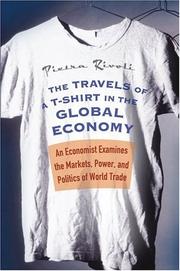
The Travels of a T-Shirt in the Global Economy

Pietra Rivoli
2005
T2 288 pages · about 4h 48m to read Open Librarygoodreads

One garment traced through every outsourced link in its chain.

Summary

Rivoli, a business school professor, bought a t-shirt in Florida and traced its supply chain backward and forward: to the cotton farm in Texas that grew the fibre, to the Chinese factory that spun and sewed it, through the trade quotas and tariffs that governed its entry into the United States, and finally to the used clothing markets in Tanzania where American donations are resold.

Her central finding contradicts both sides of the globalisation argument. The American cotton industry's dominance, she shows, comes not from free market efficiency but from two centuries of government support: land policy, subsidised water, publicly funded research, marketing programmes and direct payments, on top of a historical labour system built on slavery and sharecropping. The Chinese apparel industry's growth was similarly shaped by state policy. And the trade in both directions has been governed by quota systems, principally the Multifibre Arrangement, that had nothing to do with comparative advantage and everything to do with domestic political bargains.

Her conclusion about factory labour is nuanced. She argues the women working in Chinese apparel factories were better off than their alternatives and that the work was a stage in a transition that had occurred in every industrialising country, while documenting the conditions without minimising them.

The final section on the used clothing trade shows a genuinely free market operating, with entrepreneurial sorting and pricing, and Rivoli notes the irony that the only unregulated stage of the chain is the one nobody argues about. The book is from 2005 and the Multifibre Arrangement expired that year.

Key takeaways 7

  1. American cotton dominance rests on two centuries of government support including land policy, subsidised water, public research and direct payments rather than on market efficiency.
  2. Apparel trade has been governed by quota systems reflecting domestic political bargains rather than by comparative advantage.
  3. Quota systems produced perverse outcomes including production shifting to countries chosen for their unused quota allocations rather than for their efficiency.
  4. Women working in Chinese apparel factories were better off than in their available alternatives, which is a claim about the alternatives rather than about the conditions.
  5. Every industrialised country passed through a stage of low-wage textile manufacturing, and the sequence has been consistent enough to be predictive.
  6. The used clothing trade to Africa is the only genuinely unregulated stage of the chain and operates as a competitive entrepreneurial market.
  7. Both the free trade and anti-globalisation positions misdescribe the industry, because neither accounts for how much of it is determined by government policy.

Who should read it

Readers who want a concrete supply chain traced end to end and a demonstration of how much of global trade is determined by policy rather than by advantage.

Similar books 6

Chosen by shared topics, the entries that hold them, and the people who recommended both.
Thomas L. Friedman · 2005

Ten forces around 2000 that let anyone, anywhere compete in the global economy.

Joseph E. Stiglitz · 2002

An attack on the IMF's one-size-fits-all policies in the crises of the 1990s.

Recommended by: Patrick Collison

Rana Foroohar · 2022

The case for localisation after the pandemic supply shocks.

Richard Baldwin · 2016

Globalisation's two phases: cheap shipping of goods, then cheap movement of ideas.

Recommended by: Satya Nadella

Matthew C. Klein, Michael Pettis · 2020

Trade imbalances come from how income is shared within countries.

Thomas L. Friedman · 1999

Globalization as the new international system, seen from Amazon farms to Wall Street.

Recommended by: Mohnish Pabrai

Where it sits in the reference 4

Business models
Business themes
Industries
Economics

Topics

EconomicsSociology and CulturePolitics and GovernmentGlobalisation, development and offshore moneyGlobalisation and national societies