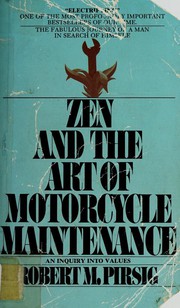
Zen and the Art of Motorcycle Maintenance
Philosophical inquiry into quality and how to reason about systems
Summary
Pirsig combines a motorcycle trip from Minnesota to California with his son Chris and two friends, and a philosophical investigation he calls the Chautauqua. The narrative recovers the history of Phaedrus, Pirsig's earlier self, a philosophy and rhetoric teacher whose pursuit of the definition of Quality led to a breakdown and to court-ordered electroconvulsive treatment.
The philosophical argument concerns the split between classical understanding, which analyses things in terms of underlying form and function, and romantic understanding, which responds to immediate appearance. Pirsig argues that this division runs through modern life and produces the alienation people feel toward technology. His proposed resolution is Quality, which he treats as prior to the division between subject and object rather than as a property either possesses.
The motorcycle maintenance material carries the argument concretely. Pirsig contrasts his own approach, understanding the machine as a system, with his friend John's refusal to engage with it at all, and he uses the problem of gumption traps, meaning the states of mind that cause a person to make errors during repair, as practical philosophy. His treatment of the stuckness that precedes real understanding is the section most often quoted.
The book was rejected by over a hundred publishers and became one of the best-selling philosophy books ever written. Professional philosophers largely dismiss the metaphysics of Quality as underdeveloped, and Pirsig's account of the history of Greek philosophy is contested. The two threads compete for attention, and readers frequently find one absorbing and the other tedious. The father and son relationship, resolved in the final pages, carries more weight than the philosophy for many readers.
Key takeaways 8
- Modern alienation from technology comes from a split between analytical understanding and immediate aesthetic response, which people treat as a choice between incompatible positions.
- Quality cannot be defined but can be recognised, and it precedes rather than follows the division between the observer and the object.
- A person who cares about what they are doing will produce good work, and technical procedure without that care produces defects that no procedure can prevent.
- Gumption traps, meaning states of mind including anxiety, boredom and impatience, cause most mechanical errors rather than lack of knowledge.
- Being stuck is the necessary condition for genuine understanding, and the impulse to escape it prevents learning.
- Peace of mind in the person doing the work is a condition of the quality of the work, which makes the mental state part of the technical process.
- Scientific method produces an unlimited number of hypotheses, so the number of possible explanations grows rather than shrinks as science advances.
- The pursuit of a single unifying idea to the exclusion of everything else destroyed Phaedrus, which Pirsig presents as a warning rather than as heroism.
Who should read it
Readers willing to work through a philosophical text disguised as a travel narrative, for the argument about care, attention and technical work.
Who recommended it 11 · 3 direct
“If you pick it up and read it, I suspect most of you will give up before you get to the end—but please try.”
“reading "Zen and the Art of Motorcycle Maintenance" by Robert Pirsig at the time... the two just combined to change how I viewed the world”
Similar books 6
Chosen by shared topics, the entries that hold them, and the people who recommended both.

Bacon's utopia of organised research; science as an institution
Recommended by: Patrick Collison, Peter Thiel

How the sciences and humanities can be unified by causal links from physics up.
“I was inspired by E. O. Wilson's book Consilience, which came out in 1998 and is a book I'd recommend.” — Michael Mauboussin
Source: MOI Global interview with Michael Mauboussin
Recommended by: Michael Mauboussin, Mohnish Pabrai
How shared fictions such as money, nations and gods let humans cooperate at scale.
“…books I've recommended, highlighted to death, or forced on friends.” — Andrew Wilkinson
Source: Andrew Wilkinson's Bookshelf, neverenough.com
Recommended by: Andrew Wilkinson, Bill Gates, Mohnish Pabrai and 38 others
History of Western philosophy from the Greeks to the Renaissance
Recommended by: Mohnish Pabrai, Nassim Nicholas Taleb

Why startups should build something new and own a small market before growing.
Recommended by: Balaji S. Srinivasan, Eric Weinstein and 36 others
Thought experiments and other tools a philosopher uses to reason carefully.
Recommended by: Patrick Collison, Shane Parrish
Where it sits in the reference 1
Topics