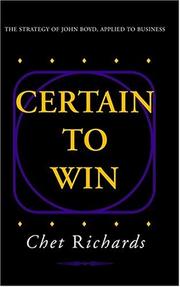
Certain to Win
Summary
Richards, a former Air Force colonel who worked with John Boyd, applies Boyd's military strategic thinking to business. Boyd published almost nothing, so most of his ideas circulate through briefings and through interpreters, and this is the main attempt to translate them for a commercial audience.
The central concept is the OODA loop, meaning observe, orient, decide, act, which Boyd developed from fighter combat. The insight usually attributed to it, that acting faster than an opponent wins, is a simplification Richards corrects. Boyd's actual argument is that orientation, meaning the mental model through which observations are interpreted, is the decisive element, and that the objective is not merely speed but generating a rapidly changing situation that the opponent cannot make sense of, which produces confusion and paralysis rather than a losing decision.
Richards covers the other Boyd concepts: the maneuver warfare distinction between attrition, which wins by destroying the opponent's forces, and maneuver, which wins by destroying their ability to function coherently; the German Auftragstaktik command approach in which subordinates are given intent rather than instructions; and Boyd's argument that organisational cohesion and mutual trust are what allow decentralised action to be coherent.
The business application is less developed than the military exposition and the examples are thin. Richards is a faithful interpreter of Boyd, which is the book's value, and readers should treat the commercial claims as extensions rather than demonstrations.
Key takeaways 7
- Orientation, meaning the mental model through which observations are interpreted, is the decisive element in the observe-orient-decide-act cycle rather than speed.
- The objective in competition is to generate a situation the opponent cannot make sense of, which produces paralysis rather than a losing decision.
- Maneuver approaches win by destroying an opponent's ability to function coherently, while attrition approaches win by destroying their resources, and the first requires far fewer resources.
- Subordinates should be given intent rather than instructions, because only they can see the situation at the point where decisions must be made.
- Decentralised action is coherent only when mutual trust and shared understanding exist, which must be built before it is needed.
- An organisation's ability to change its own orientation faster than its environment changes is what determines survival.
- Boyd published almost nothing, so his ideas reach most readers through interpreters, and the commonly cited version of the OODA loop is a simplification.
Who should read it
Operators interested in Boyd's strategic thinking and decentralised command, with the business applications read as extensions rather than as demonstrated.
Who recommended it 1
Similar books 6
Chosen by shared topics, the entries that hold them, and the people who recommended both.
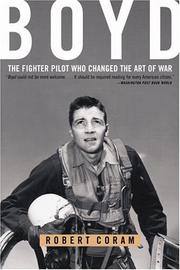
The definitive account of John Boyd and the OODA loop. Boyd's contribution was to show that strategy is fundamentally about time and adaptation: the side that observes, orients, decides, and acts faster keeps the opponent reacting rather than acting. His ideas crossed into business, software, and lean manufacturing.
Recommended by: Morgan Housel, Patrick O'Shaughnessy and 2 others
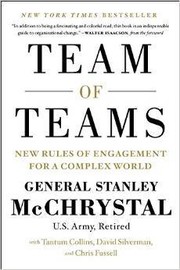
Insider account of restructuring JSOC for speed of decision.
Recommended by: Patrick Collison, Changpeng Zhao and 1 other
The original text on strategic positioning. Sun Tzu's core insight — that winning without fighting is the highest form of strategy — runs through everything that followed. Short enough to read in an afternoon, dense enough to argue about for a career.
Recommended by: Mohnish Pabrai, Evan Spiegel, Fred Wilson and 4 others
Recommended by: Mohnish Pabrai
Navy SEAL leadership doctrine adapted to running teams and firms
Recommended by: Nat Eliason, Alfred Lin, Austin Rief and 9 others
Where it sits in the reference 3
Topics