Updates

  1. Person pages list letters, writing, profiles and links as sortable tables with filters, and show each person's companies as links; Fund letters show each letter's description in its own column.
  2. Experts show a checked job title and a short description of each person; 30 more people have photographs.
  3. Every company, fund, university and publication the experts work for has a page listing the people there.
  4. Fund letters show each letter's thesis and filter by it; 225 person pages list the essays, columns and newsletter issues the person wrote.
  5. Person pages list every essay and newsletter issue a person wrote, and their own books as a table in List view.
  6. Recommends shows the five largest kinds of book and the rest under More; browse pictures load sooner.
  7. Podcasts and talks link the original episode, filter by Audio and video or Press, and list each publisher once.
  8. Pages are wider, Recommends has List and Grid, and a filter clicked again turns off.
  9. Book cards sit in a ruled grid with Open Library and Goodreads links and each book's one-line note.
  10. Funds is now Investors; each investor's styles are buttons that filter the table.
  11. Podcasts and talks on a person's page filter by year and publisher and show as a list or a grid of pictures.
  12. Quotes show only people's own words: 472 summaries written by list sites are gone.
  13. Country pages open from Browse again, and every link on the shelf lands on a page.
  14. Subject and person pages show their sections as tabs, and each book appears once on a person's page.
  15. Book cards show the quote, who said it and the source; grids show five cards to a row.
  16. On a phone, a menu holds the sections, search, Updates, Feedback and dark mode.
  17. Feedback takes a screenshot of the page with no browser prompt, opens a screenshot full size when you click it, and clears itself once sent.
  18. Book cards are centred, search names the topic each book sits in, and any text cut short shows whole on hover.
  19. Search groups its results by kind: people, companies, geographies, subjects, topics, books, funds, fund letters and papers.
  20. The Books table lists who recommended each book by name, and the browser tab names the section you are in.
  21. Feedback can take a screenshot of the page, or one you paste or choose, and opens in the corner beside Updates.
  22. Each rail button reopens its section where you left it, and Browse, Table and People show on every book and subject page.
  23. Filters grey out choices that hold nothing instead of hiding them, and Books › People filters by authors or recommenders.
  24. Feedback takes a subject line and up to three screenshots.
  25. Biographies are grouped by the person they are about: 41 new pages, from Abraham Lincoln to Lee Kuan Yew.
  26. Sport splits into 23 sports, and Religion into one topic per faith.
  27. Book lists show as cards: the cover, one recommendation quote and every recommender by name.
  28. Seventeen subjects that had two or three pages under different names now have one page each.
  29. Every page lists its Experts as authors and recommenders, with a link to them on the Experts tab.
  30. Economics, Financial history, Financial panics and Accounting are subjects of their own, with one page per financial crisis.
  31. Book, person and subject pages open inside the app, so the tabs stay in view.
  32. 996 more book covers, and photographs or logos for 227 more people and companies.
  33. Books › Browse shows every subject as cards, and the rail holds Fund letters, Papers, Experts, Books and Funds.
  34. Every topic over 150 books splits into narrower topics, each with a page of its own.

Send feedback

What is it?
Screenshots, up to 3 (optional)
or paste one with Ctrl+V

We use your email only to reply to you.

Complexity and the Economy

Complexity and the Economy

W. Brian Arthur
2014
T3 211 pages · about 3h 31m to read Open Librarygoodreads

Summary

Arthur, an economist associated with the Santa Fe Institute, collected his papers on complexity economics with connecting commentary.

His foundational contribution is the analysis of increasing returns. Standard economics assumes diminishing returns, which produces a unique equilibrium that is independent of history. Arthur showed that where increasing returns operate, meaning that adoption of a technology or product makes it more attractive to further adopters through network effects, learning curves or complementary investment, the outcome has multiple possible equilibria, the one reached depends on small early events, and the process is path dependent. Once locked in, an inferior standard can persist because switching requires coordinated action no individual can take. The QWERTY keyboard and the VHS format are the standard illustrations, both of which have been disputed empirically, but the theoretical result stands independent of the examples.

The implications for strategy are direct: in increasing returns markets, early share matters disproportionately, competition is for the market rather than in it, and the winner is not necessarily the best product.

The second body of work concerns inductive reasoning under complexity. The El Farol problem is his construction: a bar is enjoyable if fewer than sixty per cent of a population attend, everyone decides independently based on attendance history, and no deductively rational solution exists because any shared rule would be self-defeating. Agents must form hypotheses, act on them and discard those that fail, which produces a system that never settles.

The broader argument is that the economy should be modelled as a system of adapting agents whose actions continually change the environment the others face, rather than as a system that reaches equilibrium.

The papers are technical and the collection is uneven. Complexity economics has not displaced the mainstream, partly because it produces simulations rather than closed-form results that can be tested conventionally.

Key takeaways 7

  1. Where increasing returns operate, multiple equilibria exist and which one is reached depends on small early events.
  2. An inferior standard can lock in permanently because switching requires coordinated action no individual participant can initiate.
  3. In increasing returns markets, competition is for the market rather than within it, and early share matters disproportionately.
  4. The winner in a network market is not necessarily the best product, because adoption reinforces itself independently of quality.
  5. Where no deductively rational strategy exists, agents must reason inductively by forming hypotheses and discarding those that fail.
  6. A system of agents adapting to each other's behaviour never settles into equilibrium, because each adaptation changes what the others face.
  7. The economy is better modelled as continually adapting than as tending toward a determinate resting point.

Who should read it

Founders and investors in network and platform markets who want the economic theory of increasing returns, lock-in and path dependence at its source.

Similar books 6

Chosen by shared topics, the entries that hold them, and the people who recommended both.

W. Brian Arthur · 1994

Papers showing positive feedback and lock-in govern parts of the economy.
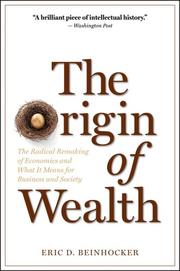
Eric D. Beinhocker · 2006

The economy as a complex evolving system rather than one in equilibrium.

Recommended by: Ryan Peterson

Michael Suk-Young Chwe · 2001

Common knowledge and coordination; why rituals and advertising work

Recommended by: Mark Zuckerberg

Rebecca Giblin, Cory Doctorow · 2022

How intermediaries capture creative-work rents; the bear case for creators.

David Dayen · 2020

Concentration traced sector by sector through its effects on customers.

Where it sits in the reference 2

Mental models
Economics

Topics

EconomicsScienceSociology and CultureComplexity and systems scienceSocial behaviour and collective action