Updates

  1. Person pages list letters, writing, profiles and links as sortable tables with filters, and show each person's companies as links; Fund letters show each letter's description in its own column.
  2. Experts show a checked job title and a short description of each person; 30 more people have photographs.
  3. Every company, fund, university and publication the experts work for has a page listing the people there.
  4. Fund letters show each letter's thesis and filter by it; 225 person pages list the essays, columns and newsletter issues the person wrote.
  5. Person pages list every essay and newsletter issue a person wrote, and their own books as a table in List view.
  6. Recommends shows the five largest kinds of book and the rest under More; browse pictures load sooner.
  7. Podcasts and talks link the original episode, filter by Audio and video or Press, and list each publisher once.
  8. Pages are wider, Recommends has List and Grid, and a filter clicked again turns off.
  9. Book cards sit in a ruled grid with Open Library and Goodreads links and each book's one-line note.
  10. Funds is now Investors; each investor's styles are buttons that filter the table.
  11. Podcasts and talks on a person's page filter by year and publisher and show as a list or a grid of pictures.
  12. Quotes show only people's own words: 472 summaries written by list sites are gone.
  13. Country pages open from Browse again, and every link on the shelf lands on a page.
  14. Subject and person pages show their sections as tabs, and each book appears once on a person's page.
  15. Book cards show the quote, who said it and the source; grids show five cards to a row.
  16. On a phone, a menu holds the sections, search, Updates, Feedback and dark mode.
  17. Feedback takes a screenshot of the page with no browser prompt, opens a screenshot full size when you click it, and clears itself once sent.
  18. Book cards are centred, search names the topic each book sits in, and any text cut short shows whole on hover.
  19. Search groups its results by kind: people, companies, geographies, subjects, topics, books, funds, fund letters and papers.
  20. The Books table lists who recommended each book by name, and the browser tab names the section you are in.
  21. Feedback can take a screenshot of the page, or one you paste or choose, and opens in the corner beside Updates.
  22. Each rail button reopens its section where you left it, and Browse, Table and People show on every book and subject page.
  23. Filters grey out choices that hold nothing instead of hiding them, and Books › People filters by authors or recommenders.
  24. Feedback takes a subject line and up to three screenshots.
  25. Biographies are grouped by the person they are about: 41 new pages, from Abraham Lincoln to Lee Kuan Yew.
  26. Sport splits into 23 sports, and Religion into one topic per faith.
  27. Book lists show as cards: the cover, one recommendation quote and every recommender by name.
  28. Seventeen subjects that had two or three pages under different names now have one page each.
  29. Every page lists its Experts as authors and recommenders, with a link to them on the Experts tab.
  30. Economics, Financial history, Financial panics and Accounting are subjects of their own, with one page per financial crisis.
  31. Book, person and subject pages open inside the app, so the tabs stay in view.
  32. 996 more book covers, and photographs or logos for 227 more people and companies.
  33. Books › Browse shows every subject as cards, and the rail holds Fund letters, Papers, Experts, Books and Funds.
  34. Every topic over 150 books splits into narrower topics, each with a page of its own.

Send feedback

What is it?
Screenshots, up to 3 (optional)
or paste one with Ctrl+V

We use your email only to reply to you.

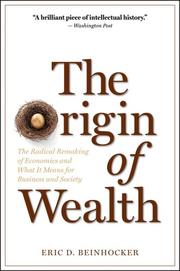
The Origin of Wealth

The Origin of Wealth

Eric D. Beinhocker
2006
T4 527 pages · about 8h 47m to read Open Librarygoodreads

Summary

Beinhocker argues that the neoclassical model of the economy, built on equilibrium, rational agents and perfect information, is wrong in its foundations, and that the economy should be modelled as a complex adaptive system that evolves. He traces the intellectual history of how nineteenth-century economists imported equilibrium mathematics from physics, and then presents the alternative developed at the Santa Fe Institute and elsewhere.

The substantive argument is that wealth is created by an evolutionary search process operating on three things simultaneously: physical technologies, social technologies meaning ways of organising people, and business plans that combine the two. Selection happens in markets. He uses agent-based modelling results, including Brian Arthur's work on increasing returns and the El Farol problem, Kauffman's work on fitness and adaptive search, and experimental economics, to argue that the economy has no equilibrium and that the distribution of outcomes is power-law rather than normal.

The implications he draws are for strategy and policy. He argues that firms should run portfolios of strategic experiments rather than commit to a single predicted future, that adaptation beats prediction, and that markets are valuable primarily as evolutionary search mechanisms rather than as allocative optimisers. The book is long, synthesising rather than original, and it is a good entry point to complexity economics. Critics note that complexity economics has produced far more critique of the standard model than replacement for it, and that agent-based models are difficult to validate empirically. Twenty years on, the promised paradigm shift in economics has not happened.

Key takeaways 7

  1. Neoclassical economics adopted equilibrium mathematics from nineteenth-century physics, and that borrowing determined a set of assumptions that do not describe real economies.
  2. Economic wealth is produced by an evolutionary process of variation, selection and amplification acting on technologies, organisational forms and business plans together.
  3. Social technologies, meaning ways of organising cooperation among people, contribute as much to growth as physical technologies do.
  4. Markets create value primarily by functioning as a search process over possible business designs, rather than by allocating resources optimally.
  5. Economic outcomes follow power-law distributions, which means extreme events are far more common than equilibrium models predict.
  6. Firms should hold a portfolio of strategic experiments and kill the failures quickly, because no one can predict which design will fit the environment.
  7. Cooperation and norm enforcement are observed features of human economic behaviour that self-interest models cannot generate.

Who should read it

Investors and strategists who want an accessible synthesis of complexity economics and its implications for treating strategy as experimentation rather than prediction.

Who recommended it 1

Similar books 6

Chosen by shared topics, the entries that hold them, and the people who recommended both.

W. Brian Arthur · 1994

Papers showing positive feedback and lock-in govern parts of the economy.

M. Mitchell Waldrop · 1992

The founding of the Santa Fe Institute and the people who built complexity science.

Steve Grand · 2000

How a game designer built artificial life from simple rules of biology.

Recommended by: Mohnish Pabrai, Jeff Bezos

Norbert Wiener · 1948

Control and communication in animals and machines run on the same principles.

Where it sits in the reference 4

Mental models
Mental models
Mental models
Economics

Topics

EconomicsScienceComplexity and systems science