Updates

  1. Person pages list letters, writing, profiles and links as sortable tables with filters, and show each person's companies as links; Fund letters show each letter's description in its own column.
  2. Experts show a checked job title and a short description of each person; 30 more people have photographs.
  3. Every company, fund, university and publication the experts work for has a page listing the people there.
  4. Fund letters show each letter's thesis and filter by it; 225 person pages list the essays, columns and newsletter issues the person wrote.
  5. Person pages list every essay and newsletter issue a person wrote, and their own books as a table in List view.
  6. Recommends shows the five largest kinds of book and the rest under More; browse pictures load sooner.
  7. Podcasts and talks link the original episode, filter by Audio and video or Press, and list each publisher once.
  8. Pages are wider, Recommends has List and Grid, and a filter clicked again turns off.
  9. Book cards sit in a ruled grid with Open Library and Goodreads links and each book's one-line note.
  10. Funds is now Investors; each investor's styles are buttons that filter the table.
  11. Podcasts and talks on a person's page filter by year and publisher and show as a list or a grid of pictures.
  12. Quotes show only people's own words: 472 summaries written by list sites are gone.
  13. Country pages open from Browse again, and every link on the shelf lands on a page.
  14. Subject and person pages show their sections as tabs, and each book appears once on a person's page.
  15. Book cards show the quote, who said it and the source; grids show five cards to a row.
  16. On a phone, a menu holds the sections, search, Updates, Feedback and dark mode.
  17. Feedback takes a screenshot of the page with no browser prompt, opens a screenshot full size when you click it, and clears itself once sent.
  18. Book cards are centred, search names the topic each book sits in, and any text cut short shows whole on hover.
  19. Search groups its results by kind: people, companies, geographies, subjects, topics, books, funds, fund letters and papers.
  20. The Books table lists who recommended each book by name, and the browser tab names the section you are in.
  21. Feedback can take a screenshot of the page, or one you paste or choose, and opens in the corner beside Updates.
  22. Each rail button reopens its section where you left it, and Browse, Table and People show on every book and subject page.
  23. Filters grey out choices that hold nothing instead of hiding them, and Books › People filters by authors or recommenders.
  24. Feedback takes a subject line and up to three screenshots.
  25. Biographies are grouped by the person they are about: 41 new pages, from Abraham Lincoln to Lee Kuan Yew.
  26. Sport splits into 23 sports, and Religion into one topic per faith.
  27. Book lists show as cards: the cover, one recommendation quote and every recommender by name.
  28. Seventeen subjects that had two or three pages under different names now have one page each.
  29. Every page lists its Experts as authors and recommenders, with a link to them on the Experts tab.
  30. Economics, Financial history, Financial panics and Accounting are subjects of their own, with one page per financial crisis.
  31. Book, person and subject pages open inside the app, so the tabs stay in view.
  32. 996 more book covers, and photographs or logos for 227 more people and companies.
  33. Books › Browse shows every subject as cards, and the rail holds Fund letters, Papers, Experts, Books and Funds.
  34. Every topic over 150 books splits into narrower topics, each with a page of its own.

Send feedback

What is it?
Screenshots, up to 3 (optional)
or paste one with Ctrl+V

We use your email only to reply to you.

Models of My Life

Models of My Life

Herbert A. Simon
1991
T2 415 pages · about 6h 55m to read Open Librarygoodreads

Memoir by the Nobel laureate who founded bounded rationality

Summary

Simon won the Nobel Prize in economics, helped found artificial intelligence, and worked across political science, psychology, organisation theory and computer science. This autobiography covers that range, from his childhood in Milwaukee and his municipal administration research in the 1930s through Carnegie Mellon, the Logic Theorist program, and the development of bounded rationality.

The intellectual through-line is a single question: how do people make decisions when they cannot possibly compute the optimum? Simon's answer, developed first in Administrative Behavior and elaborated for fifty years, is that people satisfice rather than maximise. They set an aspiration level, search until they find an option that meets it, and stop. He argues this is not a failure of rationality but the only rationality available to a system with limited computation facing an environment of enormous complexity. He applies the same framework to organisations, treating a firm as a structure that decomposes an unmanageable decision problem into parts small enough for people to handle.

Simon also uses the book to describe his own career as a series of decisions made under exactly the conditions he studied, including his account of academic politics, his fights over the direction of economics, and his view of why the field rejected his position. He is candid about which of his predictions about artificial intelligence were wrong, though he remained more optimistic than the record supported. The book is discursive and some sections on university administration are of limited interest. Read it for bounded rationality stated by its author and for the account of how a research programme crosses disciplines.

Key takeaways 7

  1. People satisfice rather than maximise, meaning they search until an option meets an aspiration level and then stop, because computing an optimum is impossible in real environments.
  2. Rationality is bounded by the computational limits of the decision-maker, so the correct model of choice is a search process rather than an optimisation.
  3. Organisations exist to decompose decision problems into pieces small enough for individuals with limited attention to handle.
  4. Attention, not information, is the scarce resource in an information-rich environment, and organisational design is largely the allocation of attention.
  5. Human problem solving proceeds by heuristic search through a space of possibilities, and this is what makes it simulable on a computer.
  6. Complex systems that survive are almost always hierarchical and nearly decomposable, because that structure allows parts to evolve without destabilising the whole.
  7. Expertise consists largely of a large stored repertoire of recognised patterns rather than superior reasoning ability.

Who should read it

Decision-makers and organisation designers who want bounded rationality and the attention-allocation argument from the person who developed them.

Who recommended it 2 · 2 direct

Similar books 6

Chosen by shared topics, the entries that hold them, and the people who recommended both.
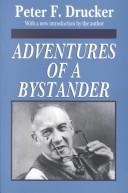
Peter F. Drucker · 1979

A memoir told through portraits of the people the author knew, from Vienna on.

Recommended by: Mohnish Pabrai, Stewart Brand
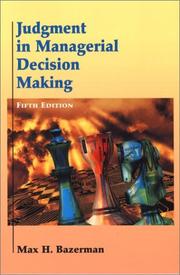
Max H. Bazerman · 1986

The biases that distort managers' decisions, with exercises that show them.

Tim Harford · 2011

Complex problems yield to trial and error, not expert plans, and how to run it.

Irving L. Janis · 1972

How the wish for agreement in close groups led to fiascos like the Bay of Pigs.

“One of my favourite books, Groupthink by Irving Janis, breaks down how small, cohesive groups of very smart people can make very bad decisions.” — Adam Weiss

Source: Weiss naming Groupthink one of his favourite books

Recommended by: Adam Weiss, Barton Biggs
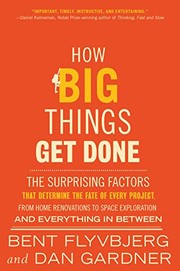
Bent Flyvbjerg, Dan Gardner · 2023

Why megaprojects overrun, and the reference-class forecasting correction.
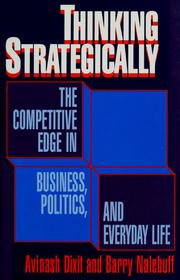
Avinash K. Dixit, Barry J. Nalebuff · 1991

Game theory without maths: look forward, reason back, and make threats credible.

Where it sits in the reference 3

Business themes
Investment philosophy
Business themes

Topics

Biography and MemoirDecision MakingScienceScientists, Doctors and ThinkersHistory and philosophy of science