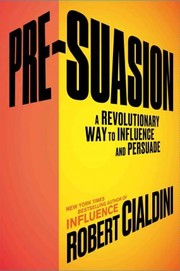
Pre-Suasion
Cialdini on framing attention before the persuasive message arrives
Summary
Cialdini's follow-up to Influence argues that what a communicator does immediately before delivering a message determines how it is received, and that this is a distinct mechanism from the six principles of influence he documented earlier.
His central claim is that directing attention to a particular concept immediately before a request makes that concept temporarily more accessible and therefore more influential in the subsequent judgment. He calls this the privileged moment for change. His examples include research showing that people asked whether they consider themselves adventurous agreed to a request more often afterwards, that a wine shop playing French music sold more French wine while customers denied any connection, and that survey response rates changed substantially with a preceding question about helpfulness.
He covers what draws attention, including the sexual, the threatening and the unexpected; the fact that attention itself confers importance, so that whatever is focused on appears more causally significant; and the mechanisms of association, in which linking a message to something already positively valued transfers the response. He adds unity as a seventh principle of influence, meaning shared identity rather than mere similarity, and argues that it operates through the category of we rather than through liking.
The research base has weakened substantially since publication, since much of it is priming research from the period most affected by the replication crisis. Several specific studies cited have failed to replicate. Cialdini has defended the work. The core observation that context shapes reception is not in doubt, and the specific effect sizes claimed should be treated with caution.
Key takeaways 8
- What a communicator does immediately before delivering a message determines how the message is received.
- Directing attention to a concept makes it temporarily more accessible and therefore more influential in the subsequent judgment.
- Attention itself confers importance, so whatever a person is focused on appears more causally significant than it is.
- Asking a question that leads people to describe themselves in a particular way changes their subsequent behaviour to match the description.
- Associating a message with something already positively valued transfers the response, which is why placement and context are not neutral.
- People deny that contextual factors influenced them while the behavioural effects are measurable, so self-report cannot detect the mechanism.
- Shared identity, meaning being part of the same category rather than merely similar, is a distinct influence mechanism that Cialdini adds as a seventh principle.
- Much of the supporting research is priming work from the period most affected by the replication crisis, and several cited studies have failed to replicate.
Who should read it
Communicators and negotiators interested in how context shapes reception, with the specific claims treated as requiring verification.
About Robert B. Cialdini
Regents' professor emeritus of psychology and marketing at Arizona State University who studies compliance and influence.
Influence organises the persuasion research into six principles - reciprocity, commitment and consistency, social proof, authority, liking, scarcity - each tested experimentally and observed in the field among salespeople, fundraisers and negotiators. Pre-Suasion adds the timing question: what an audience attends to immediately before a request changes how they answer it.
Who recommended it 2
Similar books 6
Chosen by shared topics, the entries that hold them, and the people who recommended both.
Six principles of compliance, from reciprocity to scarcity, and how sellers use them.
“…books I've recommended, highlighted to death, or forced on friends.” — Andrew Wilkinson
Source: Andrew Wilkinson's Bookshelf, neverenough.com
Recommended by: Andrew Wilkinson, Charlie Munger and 29 others

Techniques for handling people, being liked and winning others to your view.
Recommended by: Mohnish Pabrai, Alex and Books and 13 others
Cialdini's persuasion research condensed into fifty applied findings
Recommended by: Mohnish Pabrai, Charlie Munger


Recommended by: Ramit Sethi, Tim Ferriss
A step-by-step approach to business negotiation from Wharton's negotiation workshop.
Where it sits in the reference 3
Topics