Updates

  1. Person pages list letters, writing, profiles and links as sortable tables with filters, and show each person's companies as links; Fund letters show each letter's description in its own column.
  2. Experts show a checked job title and a short description of each person; 30 more people have photographs.
  3. Every company, fund, university and publication the experts work for has a page listing the people there.
  4. Fund letters show each letter's thesis and filter by it; 225 person pages list the essays, columns and newsletter issues the person wrote.
  5. Person pages list every essay and newsletter issue a person wrote, and their own books as a table in List view.
  6. Recommends shows the five largest kinds of book and the rest under More; browse pictures load sooner.
  7. Podcasts and talks link the original episode, filter by Audio and video or Press, and list each publisher once.
  8. Pages are wider, Recommends has List and Grid, and a filter clicked again turns off.
  9. Book cards sit in a ruled grid with Open Library and Goodreads links and each book's one-line note.
  10. Funds is now Investors; each investor's styles are buttons that filter the table.
  11. Podcasts and talks on a person's page filter by year and publisher and show as a list or a grid of pictures.
  12. Quotes show only people's own words: 472 summaries written by list sites are gone.
  13. Country pages open from Browse again, and every link on the shelf lands on a page.
  14. Subject and person pages show their sections as tabs, and each book appears once on a person's page.
  15. Book cards show the quote, who said it and the source; grids show five cards to a row.
  16. On a phone, a menu holds the sections, search, Updates, Feedback and dark mode.
  17. Feedback takes a screenshot of the page with no browser prompt, opens a screenshot full size when you click it, and clears itself once sent.
  18. Book cards are centred, search names the topic each book sits in, and any text cut short shows whole on hover.
  19. Search groups its results by kind: people, companies, geographies, subjects, topics, books, funds, fund letters and papers.
  20. The Books table lists who recommended each book by name, and the browser tab names the section you are in.
  21. Feedback can take a screenshot of the page, or one you paste or choose, and opens in the corner beside Updates.
  22. Each rail button reopens its section where you left it, and Browse, Table and People show on every book and subject page.
  23. Filters grey out choices that hold nothing instead of hiding them, and Books › People filters by authors or recommenders.
  24. Feedback takes a subject line and up to three screenshots.
  25. Biographies are grouped by the person they are about: 41 new pages, from Abraham Lincoln to Lee Kuan Yew.
  26. Sport splits into 23 sports, and Religion into one topic per faith.
  27. Book lists show as cards: the cover, one recommendation quote and every recommender by name.
  28. Seventeen subjects that had two or three pages under different names now have one page each.
  29. Every page lists its Experts as authors and recommenders, with a link to them on the Experts tab.
  30. Economics, Financial history, Financial panics and Accounting are subjects of their own, with one page per financial crisis.
  31. Book, person and subject pages open inside the app, so the tabs stay in view.
  32. 996 more book covers, and photographs or logos for 227 more people and companies.
  33. Books › Browse shows every subject as cards, and the rail holds Fund letters, Papers, Experts, Books and Funds.
  34. Every topic over 150 books splits into narrower topics, each with a page of its own.

Send feedback

What is it?
Screenshots, up to 3 (optional)
or paste one with Ctrl+V

We use your email only to reply to you.

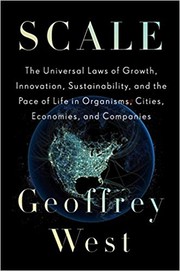
Scale

Scale

Geoffrey West
2017
T1 479 pages · about 7h 59m to read Open Librarygoodreads

Summary

West, a theoretical physicist at the Santa Fe Institute, argues that biological organisms, cities and companies all follow power-law scaling relationships, and that these relationships have quantitative explanations in the geometry of the networks that supply them.

The biological finding is that metabolic rate scales as roughly the three-quarter power of body mass across many orders of magnitude, which means larger organisms are more energy-efficient per unit mass. West explains this through the geometry of space-filling fractal distribution networks including circulatory and respiratory systems, and shows that the same exponent predicts lifespan, heart rate and other characteristics.

The urban finding is that infrastructure in cities scales sublinearly at about 0.85, so a city twice the size needs less than twice the roads and cables, while socioeconomic output including wages, patents, crime and disease scales superlinearly at about 1.15, so doubling the size produces more than double the output per capita. West argues this superlinear scaling drives urbanisation and also produces accelerating cycles of innovation, because superlinear growth reaches a singularity that only a new innovation can reset.

The company finding is that firms scale sublinearly like organisms rather than superlinearly like cities, which West connects to their finite lifespans. He reports that the mortality distribution of companies resembles that of organisms and that most public companies die within a few decades. Critics argue that the scaling exponents depend heavily on how cities and firms are defined, that correlation across aggregates does not establish the network mechanism, and that the biological three-quarter exponent is itself disputed. The scaling framework is genuinely useful and the causal explanations are less established than West presents them.

Key takeaways 8

  1. Biological metabolic rate scales as approximately the three-quarter power of mass, which means larger organisms use less energy per unit of mass.
  2. City infrastructure scales sublinearly at about 0.85, so larger cities require proportionally less physical infrastructure per person.
  3. Socioeconomic output in cities scales superlinearly at about 1.15, so doubling a city's size produces more than double its wages, patents and crime.
  4. Superlinear scaling produces accelerating growth that reaches a limit, which requires a new innovation to reset the cycle, and the interval between resets shortens.
  5. Companies scale sublinearly like organisms rather than superlinearly like cities, which West connects to their finite lifespans.
  6. Most public companies die within a few decades, and their mortality distribution resembles that of biological organisms.
  7. Cities almost never die, which West attributes to the difference between their superlinear social dynamics and the sublinear economies of firms.
  8. The causal explanation through network geometry is more contested than the scaling relationships themselves, which are better established.

Who should read it

Investors and operators interested in quantitative regularities across biology, cities and firms, treating the causal mechanism as less settled than the data.

Who recommended it 5 · 1 direct

Bill Millerreported
Marc Benioffreported
Vinod Khoslareported

Similar books 6

Chosen by shared topics, the entries that hold them, and the people who recommended both.

Didier Sornette · 2000

Power laws, scaling and critical points across physical and social systems

Recommended by: Nassim Nicholas Taleb

D'Arcy Wentworth Thompson · 1917

How mathematics and physical forces shape the forms of living things.
Albert-Laszlo Barabasi · 2018

Network science on how success and reputation compound unequally

James Gleick · 1987

Recommended by: Naval Ravikant, Stewart Brand

Where it sits in the reference 3

Mental models
Mental models
Mental models

Topics

ScienceMathematics and StatisticsComplexity and systems sciencePopular mathematics, history and puzzles