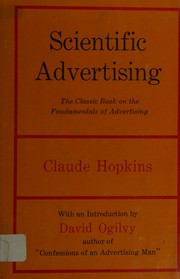
Scientific Advertising
Mail-order measurement; the origin of tracked customer acquisition cost.
Summary
Hopkins wrote this in 1923 after a career at Lord and Thomas, and it is the founding text of direct response advertising. Its central claim is that advertising should be treated as a measurable discipline in which every element is tested against response rather than judged by taste.
The method rests on measurement. Hopkins used keyed coupons so that each advertisement's response could be counted, which allowed headlines, offers, copy length and layouts to be tested against each other with real money at stake. From that testing he derived his conclusions: that headlines exist to select the right reader rather than to attract everyone; that specific claims outperform general ones, so a precise figure beats a superlative; that advertising should give information rather than assert quality; that free samples and trial offers work because they shift the risk to the seller; that a product's ordinary manufacturing process can be made compelling simply by describing it, since customers do not know it; and that long copy outperforms short copy when the reader is genuinely interested, because the only readers who continue are prospects.
His position that advertising should sell rather than entertain, and that entertainment in advertising serves the agency rather than the client, is stated absolutely.
The book takes an hour to read. Its examples are a century old and the media environment is unrecognisable. The principles it derived from measurement have been repeatedly confirmed by direct marketing and digital testing since, which is why it remains the recommended starting point for anyone doing response-based advertising.
Key takeaways 7
- Advertising should be measured by response with keyed tracking, which makes every element testable rather than a matter of judgement.
- A headline exists to select the right reader rather than to attract everyone, since attracting non-prospects costs money and produces nothing.
- Specific claims outperform general ones, so a precise figure is more persuasive than any superlative.
- Describing an ordinary manufacturing process compellingly works because customers do not know it, and the first advertiser to describe it owns it.
- Free samples and trial offers work by shifting the purchase risk from buyer to seller, which removes the reason not to try.
- Long copy outperforms short copy for genuinely interested readers, because only prospects continue reading.
- Advertising exists to sell rather than to entertain, and entertainment in an advertisement serves the agency rather than the advertiser.
Who should read it
Anyone doing direct response or measurable advertising, in the founding text whose principles digital testing has repeatedly confirmed.
Who recommended it 1 · 1 direct
Similar books 6
Chosen by shared topics, the entries that hold them, and the people who recommended both.
How direct marketing was invented, from the Columbia Record Club to American Express.
How to win and keep agency clients and write advertising that sells.
Recommended by: Mohnish Pabrai, David Cancel, Sam Parr
Rules for advertising that sells, drawn from direct-response testing.
“Ogilvy is a brilliant guy and a terrific writer. Really enjoyed this book and learned a lot.” — Mohnish Pabrai
Source: Mohnish's Bookshelf — Books on Sales & Marketing, entry 40
Recommended by: Mohnish Pabrai, David Cancel, Ev Williams and 1 other
The case that programmatic advertising is a mispriced market.
How media from the penny press to social media capture attention and resell it.
How 1950s advertisers used psychological research to sway buyers.
Where it sits in the reference 2
Topics