Updates

  1. Person pages list letters, writing, profiles and links as sortable tables with filters, and show each person's companies as links; Fund letters show each letter's description in its own column.
  2. Experts show a checked job title and a short description of each person; 30 more people have photographs.
  3. Every company, fund, university and publication the experts work for has a page listing the people there.
  4. Fund letters show each letter's thesis and filter by it; 225 person pages list the essays, columns and newsletter issues the person wrote.
  5. Person pages list every essay and newsletter issue a person wrote, and their own books as a table in List view.
  6. Recommends shows the five largest kinds of book and the rest under More; browse pictures load sooner.
  7. Podcasts and talks link the original episode, filter by Audio and video or Press, and list each publisher once.
  8. Pages are wider, Recommends has List and Grid, and a filter clicked again turns off.
  9. Book cards sit in a ruled grid with Open Library and Goodreads links and each book's one-line note.
  10. Funds is now Investors; each investor's styles are buttons that filter the table.
  11. Podcasts and talks on a person's page filter by year and publisher and show as a list or a grid of pictures.
  12. Quotes show only people's own words: 472 summaries written by list sites are gone.
  13. Country pages open from Browse again, and every link on the shelf lands on a page.
  14. Subject and person pages show their sections as tabs, and each book appears once on a person's page.
  15. Book cards show the quote, who said it and the source; grids show five cards to a row.
  16. On a phone, a menu holds the sections, search, Updates, Feedback and dark mode.
  17. Feedback takes a screenshot of the page with no browser prompt, opens a screenshot full size when you click it, and clears itself once sent.
  18. Book cards are centred, search names the topic each book sits in, and any text cut short shows whole on hover.
  19. Search groups its results by kind: people, companies, geographies, subjects, topics, books, funds, fund letters and papers.
  20. The Books table lists who recommended each book by name, and the browser tab names the section you are in.
  21. Feedback can take a screenshot of the page, or one you paste or choose, and opens in the corner beside Updates.
  22. Each rail button reopens its section where you left it, and Browse, Table and People show on every book and subject page.
  23. Filters grey out choices that hold nothing instead of hiding them, and Books › People filters by authors or recommenders.
  24. Feedback takes a subject line and up to three screenshots.
  25. Biographies are grouped by the person they are about: 41 new pages, from Abraham Lincoln to Lee Kuan Yew.
  26. Sport splits into 23 sports, and Religion into one topic per faith.
  27. Book lists show as cards: the cover, one recommendation quote and every recommender by name.
  28. Seventeen subjects that had two or three pages under different names now have one page each.
  29. Every page lists its Experts as authors and recommenders, with a link to them on the Experts tab.
  30. Economics, Financial history, Financial panics and Accounting are subjects of their own, with one page per financial crisis.
  31. Book, person and subject pages open inside the app, so the tabs stay in view.
  32. 996 more book covers, and photographs or logos for 227 more people and companies.
  33. Books › Browse shows every subject as cards, and the rail holds Fund letters, Papers, Experts, Books and Funds.
  34. Every topic over 150 books splits into narrower topics, each with a page of its own.

Send feedback

What is it?
Screenshots, up to 3 (optional)
or paste one with Ctrl+V

We use your email only to reply to you.

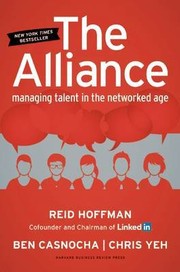
The Alliance

The Alliance

Reid Hoffman, Ben Casnocha, Chris Yeh
2014
T4 183 pages · about 3h 3m to read Open Librarygoodreads

Subtitled 'Managing Talent in the Networked Age'

Summary

Hoffman, Casnocha and Yeh argue that the employment relationship is dishonest on both sides, since companies talk about family and loyalty while conducting layoffs, and employees profess commitment while looking for their next role. They propose replacing this with an explicit alliance based on defined mutual investment over a stated period.

Their central mechanism is the tour of duty, meaning a specific commitment of two to four years with a defined mission that the employee is expected to accomplish and that will advance both the company and the employee's career. The terms are stated explicitly, including what the employee will achieve for the company and what capability, network or position they will gain in return. At the end of the tour the parties negotiate a new one or part on good terms.

They identify three types: rotational tours for entry-level roles with standard programmes, transformational tours built around a specific mission, and foundational tours for people whose career is committed to the company. Their second mechanism is deliberate network intelligence, meaning that employees should be encouraged and expected to build external networks and to bring information back, which the authors argue companies suppress out of fear of departures.

Their third is the corporate alumni network, treating departing employees as a continuing asset rather than as a loss, which they support with the recruiting, business development and information returns that firms including McKinsey obtain. The book is short and the framework is simple. The tour of duty requires a level of explicitness about departure that most managers avoid, which is the main obstacle. The alumni network argument is the least controversial and the most immediately actionable.

Key takeaways 8

  1. The employment relationship is dishonest on both sides, since companies invoke loyalty while conducting layoffs and employees profess commitment while looking elsewhere.
  2. An explicit alliance with defined mutual investment over a stated period replaces a relationship neither party believes.
  3. A tour of duty defines a specific mission over two to four years, including what the employee achieves and what capability they gain.
  4. Stating the terms of eventual departure at the outset produces more commitment during the period rather than less.
  5. Employees should be encouraged to build external networks and bring information back, which companies suppress out of fear of losing them.
  6. Departing employees are a continuing asset for recruiting, business development and market information rather than a loss.
  7. Alumni networks produce measurable returns, which firms including McKinsey have demonstrated over decades.
  8. The framework requires managers to be explicit about departure, which is the obstacle most of them will not overcome.

Who should read it

Managers and founders designing employment relationships who want an alternative to the loyalty framing that neither side believes.

About Reid Hoffman

Co-founder and former executive chairman of LinkedIn; partner at Greylock Partners; co-founder of Inflection AI

Blitzscaling and The Start-up of You outlived their news cycles and gave the industry durable vocabulary, on top of a first-rate operating and investing record.

Greylock Partners, Inflection AI, LinkedIn

Who recommended it 3

Brad Feldreported
Phil Libinreported

Similar books 6

Chosen by shared topics, the entries that hold them, and the people who recommended both.
Ram Charan · 2018

Recommended by: Keith Rabois

Laszlo Bock · 2015

Insider account of Google's people operations by its SVP of HR.

Lou Adler · 1998

Hire by defining the results a role must deliver, not the skills on a CV.

Recommended by: Patrick Collison
Patrick Lencioni · 2000

A fable of two rival firms showing why organisational health beats clever strategy.

Where it sits in the reference 4

Founders
Business themes
Business themes
Business themes

Topics

Business and ManagementLeadership