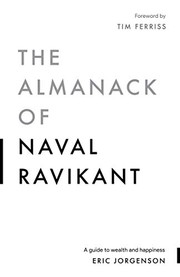
The Almanack of Naval Ravikant
Naval Ravikant's ideas on building wealth and being happy, gathered from his talks.
Summary
Jorgenson compiled this from Naval Ravikant's tweets, podcast appearances, blog posts and interviews, organised into two parts: wealth and happiness. Ravikant co-founded AngelList and invested early in Uber, Twitter, Postmates and others. He did not write the book, though he approved it, and it is free online.
The wealth section makes several specific arguments. Wealth means assets that earn while you sleep, which Ravikant distinguishes from money and from status. Status games are zero-sum and wealth creation is positive-sum, and he argues that people playing status games attack wealth creation. He argues for specific knowledge, meaning capability that cannot be trained for and that a person is uniquely suited to develop, combined with accountability, meaning taking public risk under your own name, and with leverage, which he divides into labour, capital and permissionless leverage from code and media.
His position on permissionless leverage is the most practically useful. Code and media replicate at zero marginal cost and require no one's permission to deploy, which he argues makes them the defining source of new fortunes. He also argues for hourly rate discipline, meaning setting a personal rate and refusing work below it, and against renting out time in any form because it does not compound.
The happiness section covers desire as a contract to be unhappy until you get what you want, the treatment of happiness as a skill and a choice rather than a circumstance, and meditation. It is less distinctive and repeats standard positions. The book is a compilation of aphorisms without argument or evidence, so a reader cannot test any of it. Ravikant's own outcome makes the advice hard to separate from survivorship. The leverage framework is the part that transfers.
Key takeaways 8
- Wealth means owning assets that earn while you sleep, and is distinct from money, which is a transfer mechanism, and from status, which is zero-sum.
- Specific knowledge is capability that cannot be trained for and must be found by following genuine curiosity rather than market demand.
- Leverage comes from labour, capital, or code and media, and the last requires no permission from anyone, which is what makes it available to anyone.
- Taking public accountability under your own name is required to capture the upside of being right, because anonymous work cannot be rewarded.
- Time should be priced at a fixed personal hourly rate, and any task below that rate should be delegated or left undone.
- Renting out time does not compound and produces no equity, so income from it has a permanent ceiling.
- Play long-term games with long-term people, because compounding applies to relationships and reputation as much as to capital.
- Desire is a contract to be unhappy until the thing is obtained, so choosing few desires deliberately is the mechanism for contentment.
Who should read it
Founders and solo operators thinking about how to build equity rather than income, who accept aphorism in place of argument.
Who recommended it 11 · 2 direct
Similar books 6
Chosen by shared topics, the entries that hold them, and the people who recommended both.
How shared fictions such as money, nations and gods let humans cooperate at scale.
“…books I've recommended, highlighted to death, or forced on friends.” — Andrew Wilkinson
Source: Andrew Wilkinson's Bookshelf, neverenough.com
Recommended by: Andrew Wilkinson, Bill Gates, David Perell and 40 others
Life in Nazi concentration camps, and logotherapy: finding meaning to survive.
“What's more certain to me is that we all need a why, as Viktor Frankl told us in Man's Search for Meaning.” — David Heinemeier Hansson
Source: Universal Basic Dead End
Recommended by: David Heinemeier Hansson, David Perell and 29 others
Time management for a life of about four thousand weeks, and the limits it sets.
“Give up hope and embrace your limits. Everything you do means giving up something else. Say yes to less. He’s one of my favorite authors, so wonderfully thorough, but I already agree and am living this way. (My “Hell Yeah or No” was about this subject.) Still, I’d recommend it to anyone.” — Derek Sivers
Source: Derek Sivers book notes (primary, rated list) · Rating: 8/10
Recommended by: Andrew Wilkinson, Derek Sivers, Sahil Bloom and 1 other
A venture adviser on startups and the trap of the deferred life plan.
Recommended by: Nat Eliason, Patrick Collison, Ev Williams and 3 others

Twelve rules for living, each drawn from clinical practice, biology and myth.
“A unique thinker with strong opinions presented as indisputable fact. More surprisingly interesting ideas than almost any book I've ever read. Extremely thoughtful, but occasionally abruptly concludes with an unsupported point. It has a conservative “this is how it is” certainty. It’s a broad collection of thoughtful insights on life, mixed with a lot of Bible interpretation.” — Derek Sivers
Source: Derek Sivers book notes (primary, rated list) · Rating: 9/10
Recommended by: Derek Sivers, Guy Spier, Nat Eliason and 8 others

Why Eurasian societies conquered others: the role of geography, crops and animals.
“This is an insightful read on the pace at which societies develop and why.” — Christopher Bloomstran
Source: Semper Augustus 2023 Letter to Clients, 'Worldly Wisdom', p. 81
Recommended by: Charlie Munger, Christopher Bloomstran and 17 others
Where it sits in the reference 1
Topics 5
As an Amazon Associate I earn from qualifying purchases.