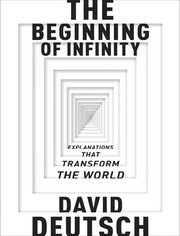
The Beginning of Infinity
Summary
Deutsch, a physicist who did foundational work in quantum computation, argues that knowledge growth is unbounded and that the mechanism is the creation of explanations that are hard to vary. His central criterion is that a good explanation accounts for what it purports to account for while having every component doing necessary work, so that any change to it destroys its explanatory power. Bad explanations can be adjusted to accommodate any evidence.
He argues against empiricism as the source of scientific knowledge, holding that observation cannot generate theories and that conjecture followed by criticism does, which follows Popper. He argues against inductivism directly, and against the claim that scientific theories are merely instruments for prediction.
His larger claim is that anything not forbidden by the laws of physics is achievable given the right knowledge, which he calls the principle of optimism, and that all problems are soluble, though solving one produces new ones. He applies the framework to the multiverse interpretation of quantum mechanics, to the evolution of culture, to the difference between static and dynamic societies, to artificial general intelligence, to aesthetics and to political decision-making, where he argues that the right criterion for institutions is the ease of removing bad policies rather than the quality of the selection process.
The book is demanding and the chapters vary considerably in quality. The physics sections assume comfort with unfamiliar arguments. Critics find the optimism unfalsifiable and the extensions into aesthetics and politics weaker than the epistemology. The hard-to-vary criterion is the most usable idea and applies directly to evaluating business theses and strategic explanations.
Key takeaways 8
- Good explanations are hard to vary, meaning every component does necessary work and any change destroys the explanation's power.
- Knowledge grows through conjecture and criticism rather than through the accumulation of observations, since observation cannot generate a theory.
- Anything not forbidden by the laws of physics is achievable given the relevant knowledge, which makes knowledge rather than resources the binding constraint.
- All problems are soluble, and solving them creates new problems, so the absence of problems would indicate stagnation rather than success.
- Static societies persist by suppressing the creation of new ideas, and dynamic societies are historically rare and recent.
- Institutions should be judged by how easily bad policies and bad leaders can be removed, rather than by how well they select good ones.
- Explanations that can be adjusted to fit any evidence explain nothing, which is the test that distinguishes science from its imitations.
- Progress has no known limit, and claims that a field or a civilisation has reached its ceiling are claims about current knowledge rather than about reality.
Who should read it
Readers who want a rigorous criterion for what makes an explanation good, applicable to evaluating investment theses and strategic reasoning.
Who recommended it 8 · 2 direct
Similar books 6
Chosen by shared topics, the entries that hold them, and the people who recommended both.

Reality through four strands: many-worlds physics, computation, evolution, Popper.
Recommended by: Naval Ravikant, Patrick Collison and 2 others

Short essays on the scientific concepts most worth adopting
Recommended by: Morgan Housel, Patrick Collison

How the sciences and humanities can be unified by causal links from physics up.
“I was inspired by E. O. Wilson's book Consilience, which came out in 1998 and is a book I'd recommend.” — Michael Mauboussin
Source: MOI Global interview with Michael Mauboussin
Recommended by: Michael Mauboussin, Mohnish Pabrai

Science moves through long stretches of normal work broken by paradigm shifts.
Recommended by: Nat Eliason, Charlie Munger, Mark Zuckerberg and 5 others

How shared fictions such as money, nations and gods let humans cooperate at scale.
“…books I've recommended, highlighted to death, or forced on friends.” — Andrew Wilkinson
Source: Andrew Wilkinson's Bookshelf, neverenough.com
Recommended by: Andrew Wilkinson, Bill Gates, Mohnish Pabrai and 38 others
Thought experiments and other tools a philosopher uses to reason carefully.
Recommended by: Patrick Collison, Shane Parrish
Where it sits in the reference 1
Topics