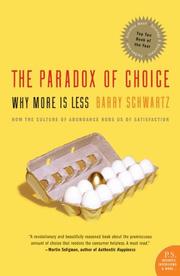
The Paradox of Choice
Why more options reduce satisfaction and worsen decisions
Summary
Schwartz argues that increasing the number of options available reduces both the likelihood that a person will choose at all and their satisfaction with what they choose. His claim is that choice improves welfare up to a point and reduces it beyond that point.
The mechanisms he identifies include the increased effort of evaluation; the rising opportunity cost, since each rejected alternative's best features are subtracted mentally from the chosen option; increased expectations, since with many options a person expects to find something perfect; and increased self-blame when the outcome disappoints, because with many options available the failure must be the chooser's.
His distinction between maximisers and satisficers is the practical core. Maximisers seek the best available option and therefore must examine all of them, which produces worse subjective outcomes despite frequently producing objectively better choices. Satisficers accept the first option meeting their criteria and report higher satisfaction. The supporting research includes Iyengar and Lepper's jam study, in which a display of twenty-four varieties attracted more attention and produced fewer purchases than a display of six.
The replication record is poor. Meta-analyses of choice overload find effects near zero on average, with the effect appearing only under specific conditions including time pressure and unfamiliarity with the category. The jam study has not replicated reliably. Schwartz has acknowledged some of this. The maximiser and satisficer distinction has held up better than the choice overload claim. Readers should treat the central thesis as conditional rather than general.
Key takeaways 8
- Increasing the number of options improves welfare up to a point and reduces it beyond, according to the book's central claim.
- Each rejected alternative's best features are subtracted mentally from the chosen option, which reduces satisfaction as options increase.
- Many options raise the expectation of finding something perfect, which guarantees that the actual choice disappoints.
- When many options were available, a disappointing outcome is attributed to the chooser rather than to the circumstances.
- Maximisers who seek the best available option report worse subjective outcomes than satisficers despite frequently choosing objectively better.
- Accepting the first option meeting defined criteria produces higher satisfaction than examining all alternatives.
- Making a decision irreversible increases satisfaction with it, because the possibility of revision keeps the alternatives active.
- Meta-analyses find choice overload effects near zero on average, which means the central thesis holds only under specific conditions.
Who should read it
Product and marketing people deciding how many options to present, and individuals who examine every alternative before deciding, with the evidence treated as conditional.
Who recommended it 3 · 2 direct
“It is almost ten years since Barry Schwartz published his popular psychology book "The Paradox of Choice".”
Similar books 6
Chosen by shared topics, the entries that hold them, and the people who recommended both.
Michael Lewis's account of the Kahneman-Tversky collaboration works as intellectual biography and as a second path through the research for readers who find academic writing slow. The friendship and its eventual fracture clarifies how two very different minds produced work that neither could have done alone.
Recommended by: Andrew Wilkinson, Mohnish Pabrai, Ray Dalio and 6 others
Why people mistake luck for skill, above all in markets.
“Fooled by Randomness is a serious, intellectually sophisticated book, well worth reading carefully. At times, the book is condescending. Nevertheless, there are some great insights.” — Barton Biggs
Source: Biggs on a sophisticated book worth reading carefully
Recommended by: Barton Biggs, Michael Mauboussin and 11 others
How behavioural economics was built against economists who assumed rational agents.
“He opens his new book, Misbehaving, with Vilfredo Pareto's assertion” — Howard Marks
Source: Oaktree memo 'On the Couch'
Recommended by: Howard Marks, Peter Mallouk, Tyler Cowen
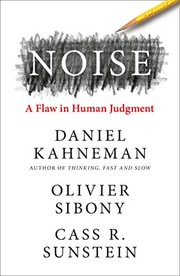
Kahneman died 27 March 2024; this was his last book.

Experiments showing most cheating is many people cheating a little.
Recommended by: Mohnish Pabrai
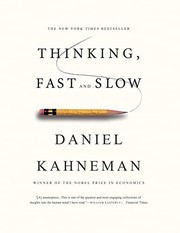
Kahneman's synthesis of behavioral economics is the cognitive science underpinning every negotiation tactic. Anchoring, loss aversion, framing effects, and the planning fallacy — understanding why these biases operate, not just that they exist, makes you harder to exploit and more honest about your own irrationality.
“…books I've recommended, highlighted to death, or forced on friends.” — Andrew Wilkinson
Source: Andrew Wilkinson's Bookshelf, neverenough.com
Recommended by: Andrew Wilkinson, Charles de Vaulx and 32 others
Where it sits in the reference 3
Topics