
The Honest Truth About Dishonesty: How We Lie to Everyone--- Especially Ourselves
Ariely's research on cheating shows that most people will bend rules slightly but not dramatically — a finding that complicates simple models of self-interest. His fudge factor theory is at odds with rational-choice accounts of honesty.
Summary
Ariely examines dishonesty experimentally, arguing that most cheating is done by many people cheating a small amount rather than by a few people cheating a great deal.
His principal instrument is the matrix task, in which participants solve puzzles for money and can either report their score honestly or, in the condition where they shred their answer sheet, misreport it. His finding is that participants inflate their scores by a small consistent margin, that almost everyone does it and almost nobody does it to the maximum, and that the amount is unaffected by the probability of being caught, which contradicts the standard economic model of dishonesty as a cost-benefit calculation.
His explanation is a fudge factor: people cheat up to the point where they can still regard themselves as honest, and the size of that margin is what varies with context. He reports that it increases with distance from money, with the presence of others cheating in the same social group, with tiredness, with prior self-justification and with conflicts of interest, and decreases when people are reminded of moral standards before rather than after acting, including by signing a declaration at the top of a form rather than the bottom.
The honesty-priming and moral reminder findings have failed to replicate, and the signature-at-the-top result was retracted after the underlying data in a related paper was found to be fabricated, a matter in which Ariely was involved. That is a serious problem for the book's most cited practical claim and readers should treat the specific results with substantial caution.
Key takeaways 7
- Most dishonesty consists of many people cheating a small amount rather than a few people cheating a great deal.
- The amount people cheat is largely unaffected by the probability of being caught, which contradicts the model of dishonesty as a cost-benefit calculation.
- People cheat up to the point where they can still regard themselves as honest, and that margin is what varies with circumstances.
- Distance from money increases cheating, so dishonesty involving tokens, credits or non-cash instruments exceeds dishonesty involving cash.
- Observing someone from one's own group cheat increases cheating, while observing an outsider cheat decreases it.
- Conflicts of interest change judgement without the person perceiving any change, which is why disclosure does not solve them.
- The moral reminder findings, including the widely cited signature-at-the-top result, failed to replicate and the related paper was retracted over fabricated data.
Who should read it
Operators designing controls and incentive systems, treating the specific experimental results with substantial caution given the replication and data failures.
About Dan Ariely
Professor of psychology and behavioral economics at Duke University who runs experiments on how people misjudge value.
Predictably Irrational reports controlled experiments showing that valuation errors are systematic and repeatable: relative comparison, the pull of free, the effect of price on expected quality. The findings bear directly on pricing, bundling, incentive design and any forecast that assumes rational buyers.
Who recommended it 1 · 1 direct
Similar books 6
Chosen by shared topics, the entries that hold them, and the people who recommended both.

Why people mistake luck for skill, above all in markets.
“Fooled by Randomness is a serious, intellectually sophisticated book, well worth reading carefully. At times, the book is condescending. Nevertheless, there are some great insights.” — Barton Biggs
Source: Biggs on a sophisticated book worth reading carefully
Recommended by: Barton Biggs, Michael Mauboussin and 11 others
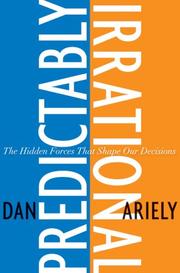
Experiments showing that people depart from rational choice in repeatable ways.
Recommended by: Mohnish Pabrai, Alfred Lin, Anna Cheng and 6 others
How behavioural economics was built against economists who assumed rational agents.
“He opens his new book, Misbehaving, with Vilfredo Pareto's assertion” — Howard Marks
Source: Oaktree memo 'On the Couch'
Recommended by: Howard Marks, Peter Mallouk, Tyler Cowen

Rare, unforeseen, high-impact events drive history, explained only after the fact.
“The message of The Black Swan is how important it is to realize that the things everyone rules out can still come to pass.” — Howard Marks
Source: Oaktree memo 'The Limits to Negativism'
Recommended by: Howard Marks, Marc Andreessen, Nat Eliason and 18 others
Incerto volume 4
“Nassim Taleb, author of the new book Antifragile, praises volatility and criticises those who would artificially damp it at great unseen cost. Taleb advises us to be 'anti-fragile'. This is exactly…” — Seth Klarman
Source: Klarman on Taleb's praise of volatility and what Baupost strives for
Recommended by: Mohnish Pabrai, Nat Eliason and 25 others
Kahneman died 27 March 2024; this was his last book.
Where it sits in the reference 4
Topics