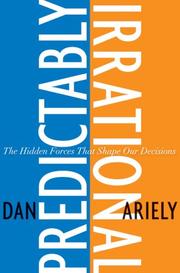
Predictably Irrational
Ariely's contribution is showing that our irrationality is not random — it follows predictable patterns that can be mapped and, to some degree, engineered around. His experiments on relativity, free, and social versus market norms each isolate a mechanism that pure psychology literature tends to bury in statistical tables.
Summary
Ariely presents experimental findings on systematic departures from rational economic behaviour, organised by phenomenon and drawn largely from his own laboratory work at MIT and Duke. The argument is that these deviations are not random noise but repeatable patterns that can be predicted and exploited.
The topics include relativity, in which a deliberately inferior third option shifts choices between the other two; the effect of arbitrary anchors on willingness to pay, demonstrated by having subjects write down the last two digits of their social security number before bidding; the disproportionate power of free, where a price reduction to zero changes behaviour far more than an equivalent reduction to one cent; the distinction between social norms and market norms, where introducing payment destroys behaviour that was freely given; the effect of arousal on decision-making; procrastination and self-control; the endowment effect; the cost of keeping options open; the effect of expectations on experience, including wine and beer tastings; and the finding that placebo pricing changes measured pain relief.
The dishonesty chapters argue that most people cheat by a small amount when the opportunity exists, that the amount does not increase with the probability of being caught, and that reminders of moral standards reduce it.
The replication record is a serious problem. Ariely's dishonesty research has been substantially discredited, including a 2012 insurance-form signature study found to contain fabricated data, and Duke conducted an investigation. Several other findings in the book have replicated weakly. The anchoring and relativity results are better supported. Readers should treat every claim in this book as requiring independent verification before use.
Key takeaways 8
- People evaluate options relative to each other rather than absolutely, so adding a deliberately inferior option changes which of the others is chosen.
- Arbitrary numbers encountered before a valuation decision anchor the amount a person will pay, even when they know the number is meaningless.
- A price of zero produces a behavioural response disproportionate to the size of the discount, which makes free a distinct category rather than a low price.
- Social norms and market norms are separate systems, and introducing money into a social exchange destroys the social behaviour permanently.
- People value what they own above what they would pay to acquire it, which makes trial ownership an effective sales mechanism.
- Keeping options open has a cost that people systematically fail to count, so they preserve alternatives past the point where it damages them.
- Expectations change measured experience, so the same product tastes and performs differently depending on what the person was told.
- Several findings in this book, particularly those on dishonesty, rest on research that has since been discredited and should not be cited.
Who should read it
Founders and marketers who want the anchoring and relativity results for pricing decisions, with the dishonesty material treated as unreliable.
About Dan Ariely
Professor of psychology and behavioral economics at Duke University who runs experiments on how people misjudge value.
Predictably Irrational reports controlled experiments showing that valuation errors are systematic and repeatable: relative comparison, the pull of free, the effect of price on expected quality. The findings bear directly on pricing, bundling, incentive design and any forecast that assumes rational buyers.
Who recommended it 9 · 1 direct
Similar books 6
Chosen by shared topics, the entries that hold them, and the people who recommended both.
How behavioural economics was built against economists who assumed rational agents.
“He opens his new book, Misbehaving, with Vilfredo Pareto's assertion” — Howard Marks
Source: Oaktree memo 'On the Couch'
Recommended by: Howard Marks, Peter Mallouk, Tyler Cowen

Experiments showing most cheating is many people cheating a little.
Recommended by: Mohnish Pabrai
Nudge: The Final Edition published 2021.
Recommended by: Tristan Harris
Mullainathan and Shafir's research on cognitive bandwidth shows that financial scarcity — not just poverty but any experience of not having enough — tunnels attention in ways that make long-term planning harder and short-term mistakes more likely. It reframes willpower-based explanations of financial failure without excusing the structural causes.
Recommended by: Mohnish Pabrai, Daniel Kahneman and 1 other
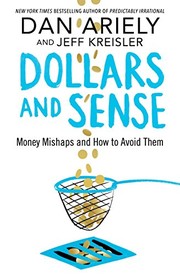
Why money is hard to think about, and the errors people make in spending.
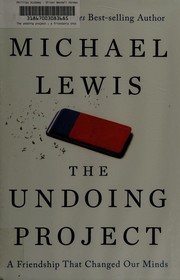
Michael Lewis's account of the Kahneman-Tversky collaboration works as intellectual biography and as a second path through the research for readers who find academic writing slow. The friendship and its eventual fracture clarifies how two very different minds produced work that neither could have done alone.
Recommended by: Andrew Wilkinson, Mohnish Pabrai, Ray Dalio and 6 others
Where it sits in the reference 4
Topics