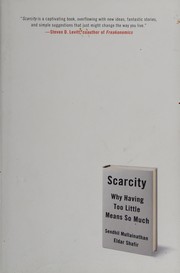
Scarcity: Why Having Too Little Means So Much
Mullainathan and Shafir's research on cognitive bandwidth shows that financial scarcity — not just poverty but any experience of not having enough — tunnels attention in ways that make long-term planning harder and short-term mistakes more likely. It reframes willpower-based explanations of financial failure without excusing the structural causes.
Summary
Mullainathan, an economist, and Shafir, a psychologist, argue that scarcity of any resource, whether money, time, food or social connection, produces a common psychological state that impairs decision-making, and that this impairment is a consequence of the scarcity rather than a cause of it.
Their central mechanism is bandwidth. Scarcity captures attention involuntarily, which produces a focus dividend, meaning better performance on the immediate scarce dimension, and simultaneously reduces the cognitive capacity available for everything else. They report experiments in which participants primed to think about a financial problem performed worse on cognitive tests, with effects they compare to a night's lost sleep, and field work with Indian sugarcane farmers who performed better on the same tests after harvest than before it, when the same individuals were financially constrained.
Their related concept is tunnelling, meaning that scarcity produces neglect of anything outside the immediate problem, including maintenance, planning and opportunities with delayed returns. This explains behaviour that appears irrational from outside, including borrowing at high rates, skipping preventive expenditure and missing deadlines.
Slack, meaning unused capacity, is what allows people to absorb shocks and to make errors without consequence, and they argue that its absence rather than any characteristic of poor people explains much of the observed behaviour. Their policy implications include designing programmes that economise on the bandwidth of the people using them. Some of the priming experiments have replicated weakly and the effect sizes reported are contested. The sugarcane farmer study is the strongest evidence and has been challenged on sample and analysis. The bandwidth framing has held up better than the specific measurements.
Key takeaways 8
- Scarcity of any resource produces a common psychological state that impairs decision-making, and the impairment follows from the scarcity rather than causing it.
- Scarcity captures attention involuntarily, which improves performance on the immediate problem and reduces the capacity available for everything else.
- Tunnelling produces neglect of anything outside the immediate problem, including maintenance, planning and opportunities with delayed returns.
- Behaviour that appears irrational from outside, including borrowing at high rates and skipping preventive expenditure, follows directly from bandwidth constraints.
- Slack, meaning unused capacity, is what allows people to absorb shocks and make errors without consequence.
- The same individuals performed better on cognitive tests when not financially constrained, which separates the effect from any personal characteristic.
- Programmes serving people under scarcity should economise on their bandwidth rather than requiring more decisions and paperwork.
- Several supporting experiments have replicated weakly and the reported effect sizes are contested.
Who should read it
Operators and policy readers who want a mechanism explaining decision-making under constraint, applicable to poverty, deadlines and understaffed teams alike.
Who recommended it 3 · 1 direct
Similar books 6
Chosen by shared topics, the entries that hold them, and the people who recommended both.
Experiments showing that people depart from rational choice in repeatable ways.
Recommended by: Mohnish Pabrai, Alfred Lin, Anna Cheng and 6 others
How behavioural economics was built against economists who assumed rational agents.
“He opens his new book, Misbehaving, with Vilfredo Pareto's assertion” — Howard Marks
Source: Oaktree memo 'On the Couch'
Recommended by: Howard Marks, Peter Mallouk, Tyler Cowen

Why people mistake luck for skill, above all in markets.
“Fooled by Randomness is a serious, intellectually sophisticated book, well worth reading carefully. At times, the book is condescending. Nevertheless, there are some great insights.” — Barton Biggs
Source: Biggs on a sophisticated book worth reading carefully
Recommended by: Barton Biggs, Michael Mauboussin and 11 others

Experiments showing most cheating is many people cheating a little.
Recommended by: Mohnish Pabrai
Incerto volume 4
“Nassim Taleb, author of the new book Antifragile, praises volatility and criticises those who would artificially damp it at great unseen cost. Taleb advises us to be 'anti-fragile'. This is exactly…” — Seth Klarman
Source: Klarman on Taleb's praise of volatility and what Baupost strives for
Recommended by: Mohnish Pabrai, Nat Eliason and 25 others

Daniel Gilbert's accessible account of affective forecasting — our poor ability to predict what will make us happy. His research on immune neglect and focalism is less cited than Kahneman's work but equally well-evidenced.
Recommended by: Andrew Wilkinson, Mohnish Pabrai and 3 others
Where it sits in the reference 2
Topics