Updates

  1. Person pages list letters, writing, profiles and links as sortable tables with filters, and show each person's companies as links; Fund letters show each letter's description in its own column.
  2. Experts show a checked job title and a short description of each person; 30 more people have photographs.
  3. Every company, fund, university and publication the experts work for has a page listing the people there.
  4. Fund letters show each letter's thesis and filter by it; 225 person pages list the essays, columns and newsletter issues the person wrote.
  5. Person pages list every essay and newsletter issue a person wrote, and their own books as a table in List view.
  6. Recommends shows the five largest kinds of book and the rest under More; browse pictures load sooner.
  7. Podcasts and talks link the original episode, filter by Audio and video or Press, and list each publisher once.
  8. Pages are wider, Recommends has List and Grid, and a filter clicked again turns off.
  9. Book cards sit in a ruled grid with Open Library and Goodreads links and each book's one-line note.
  10. Funds is now Investors; each investor's styles are buttons that filter the table.
  11. Podcasts and talks on a person's page filter by year and publisher and show as a list or a grid of pictures.
  12. Quotes show only people's own words: 472 summaries written by list sites are gone.
  13. Country pages open from Browse again, and every link on the shelf lands on a page.
  14. Subject and person pages show their sections as tabs, and each book appears once on a person's page.
  15. Book cards show the quote, who said it and the source; grids show five cards to a row.
  16. On a phone, a menu holds the sections, search, Updates, Feedback and dark mode.
  17. Feedback takes a screenshot of the page with no browser prompt, opens a screenshot full size when you click it, and clears itself once sent.
  18. Book cards are centred, search names the topic each book sits in, and any text cut short shows whole on hover.
  19. Search groups its results by kind: people, companies, geographies, subjects, topics, books, funds, fund letters and papers.
  20. The Books table lists who recommended each book by name, and the browser tab names the section you are in.
  21. Feedback can take a screenshot of the page, or one you paste or choose, and opens in the corner beside Updates.
  22. Each rail button reopens its section where you left it, and Browse, Table and People show on every book and subject page.
  23. Filters grey out choices that hold nothing instead of hiding them, and Books › People filters by authors or recommenders.
  24. Feedback takes a subject line and up to three screenshots.
  25. Biographies are grouped by the person they are about: 41 new pages, from Abraham Lincoln to Lee Kuan Yew.
  26. Sport splits into 23 sports, and Religion into one topic per faith.
  27. Book lists show as cards: the cover, one recommendation quote and every recommender by name.
  28. Seventeen subjects that had two or three pages under different names now have one page each.
  29. Every page lists its Experts as authors and recommenders, with a link to them on the Experts tab.
  30. Economics, Financial history, Financial panics and Accounting are subjects of their own, with one page per financial crisis.
  31. Book, person and subject pages open inside the app, so the tabs stay in view.
  32. 996 more book covers, and photographs or logos for 227 more people and companies.
  33. Books › Browse shows every subject as cards, and the rail holds Fund letters, Papers, Experts, Books and Funds.
  34. Every topic over 150 books splits into narrower topics, each with a page of its own.

Send feedback

What is it?
Screenshots, up to 3 (optional)
or paste one with Ctrl+V

We use your email only to reply to you.

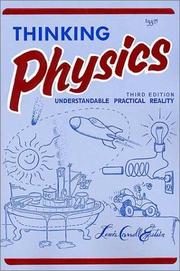
Thinking Physics

Thinking Physics

Lewis Carroll Epstein
1979
T3 596 pages · about 9h 56m to read Open Librarygoodreads

Summary

Epstein wrote a book of physics questions in multiple-choice form, each followed by an explanation. There are several hundred, covering mechanics, fluids, heat, vibrations, light, electricity, relativity and quantum ideas. The questions require no calculation and almost no algebra.

The pedagogical claim is that most physics teaching produces students who can manipulate equations but hold incorrect intuitions about physical situations, and that the fastest way to correct this is to force a commitment to an answer before receiving an explanation. The questions are constructed so that the plausible wrong answer corresponds to a common misconception. A typical example asks what happens to the water level when ice floating in a glass melts, or which of two identical bullets fired horizontally and dropped hits the ground first.

The explanations are qualitative and use physical reasoning rather than formulas, often with hand-drawn diagrams. Epstein consistently reduces problems to symmetry, conservation, limiting cases and dimensional reasoning.

The book is aimed at people learning physics rather than at practitioners, and its subject is physics rather than business, so its use to an investor or operator is indirect: it trains the habit of committing to a prediction and then checking it, and of testing an argument at its extremes. Some readers find the deliberately informal style irritating and the absence of mathematics limiting for anyone who needs to calculate rather than reason. The physics is standard and correct; the edition history is long and later printings expand the coverage.

Key takeaways 7

  1. Physical intuition and equation manipulation are separate skills, and formal instruction develops the second while leaving the first wrong.
  2. Committing to an answer before reading the explanation produces learning that passive reading does not.
  3. Most physics problems can be solved qualitatively by examining limiting cases rather than by calculation.
  4. Symmetry arguments settle many questions that appear to require computation.
  5. Common misconceptions are systematic rather than random, so questions can be designed to expose specific ones.
  6. Checking whether an answer behaves sensibly at extremes catches most reasoning errors.
  7. Understanding a physical situation means being able to predict it without the equation, not being able to derive the equation.

Who should read it

Anyone who wants to test whether their physical intuition matches reality, and readers looking to practise committing to predictions before seeing the answer.

Who recommended it 1 · 1 direct

“There's another great book that's called Thinking Physics. I open this one all the time.”

Similar books 6

Chosen by shared topics, the entries that hold them, and the people who recommended both.

Richard P. Feynman · 1994

Six physics lectures with little maths: atoms, energy, gravity and quantum behaviour.

Recommended by: Naval Ravikant
J. E. Gordon · 1981

Why structures hold up or fail: tension, compression, shear and fracture explained.

Recommended by: Elon Musk
David Deutsch · 2011

Knowledge can grow without limit through good explanations that are hard to vary.

David Deutsch · 1997

Reality through four strands: many-worlds physics, computation, evolution, Popper.

Bill Bryson · 2003

How scientists came to know what they know, from cosmology and geology to biology.

Edward O. Wilson · 1998

How the sciences and humanities can be unified by causal links from physics up.

“I was inspired by E. O. Wilson's book Consilience, which came out in 1998 and is a book I'd recommend.” — Michael Mauboussin

Source: MOI Global interview with Michael Mauboussin

Recommended by: Michael Mauboussin, Mohnish Pabrai

Where it sits in the reference 2

Mental models
Mental models

Topics

ScienceEducation and LearningPhysics and chemistry textbooks