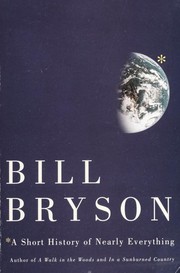
A Short History of Nearly Everything
Popular survey of how science established what it currently knows
Summary
Bryson, a travel writer with no scientific training, set out to understand how scientists know what they claim to know, and wrote a survey of cosmology, geology, chemistry, physics, palaeontology and biology organised around the people who made the discoveries and the methods they used.
The structure moves from the largest scale to the smallest and then to life. He covers the Big Bang and the evidence for it, the measurement of the Earth's size and age, the discovery of the atom and of subatomic structure, plate tectonics and the decades of resistance to it, the mass extinctions, the discovery of DNA, and human evolution. He returns repeatedly to two themes: how recently most of this was established, and how much remains unknown.
Bryson concentrates on the human circumstances of discovery, including the disputes, the errors, the people who were ignored and the people who took credit. The account of Alfred Wegener's continental drift hypothesis being rejected for fifty years, and of Barry Marshall infecting himself to prove bacteria caused ulcers, are examples of his recurring interest in resistance to correct ideas. He is also consistent about uncertainty, reporting the size of error bars, the disagreements among specialists and the places where confident textbook statements rest on thin evidence.
The book was published in 2003 and parts are out of date, particularly in genetics, cosmology and palaeoanthropology. Scientists have identified errors, which later editions partly corrected. Bryson writes as an outsider, which produces both the accessibility and the occasional misstatement. It is a survey rather than a source, and its best use is as a demonstration of how scientific consensus forms and how often it is wrong first.
Key takeaways 8
- Most of what is known about the age, size and composition of the universe and the Earth was established within the last century.
- Correct theories are routinely rejected for decades, and continental drift was dismissed for fifty years before plate tectonics made it undeniable.
- Scientific discoveries frequently come from outsiders and amateurs whose lack of standing delayed acceptance rather than the quality of their evidence.
- Credit for discovery is often assigned to whoever published most effectively rather than to whoever did the work.
- The proportion of species that have gone extinct exceeds ninety-nine percent, which makes extinction the normal outcome rather than the exception.
- Large parts of basic science remain unresolved, including much of what happens beneath the Earth's surface and most of the microbial world.
- Measurements that appear to be simple facts, including the Earth's age and the distance to stars, required centuries of ingenious indirect methods.
- Human existence depends on a set of conditions so specific that their combination has no known parallel.
Who should read it
Readers who want a survey of how scientific knowledge was actually established, useful as a demonstration of how consensus forms and fails.
Who recommended it 7 · 3 direct
Similar books 6
Chosen by shared topics, the entries that hold them, and the people who recommended both.
A history of discovery: time and the clock, the earth and seas, nature and society.
Recommended by: Jim Collins, Stewart Brand
How the sciences and humanities can be unified by causal links from physics up.
“I was inspired by E. O. Wilson's book Consilience, which came out in 1998 and is a book I'd recommend.” — Michael Mauboussin
Source: MOI Global interview with Michael Mauboussin
Recommended by: Michael Mauboussin, Mohnish Pabrai
The search for the periodic table; reasoning from the elements upward
Recommended by: Bill Gates
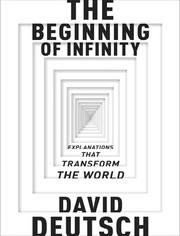
Knowledge can grow without limit through good explanations that are hard to vary.
Recommended by: Nat Eliason, Naval Ravikant, Albert Wenger and 5 others
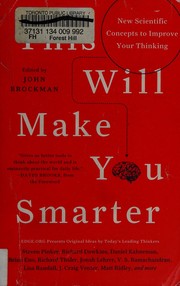
Short essays on the scientific concepts most worth adopting
Recommended by: Morgan Housel, Patrick Collison
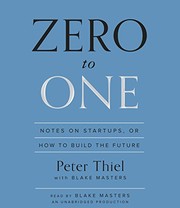
Why startups should build something new and own a small market before growing.
Recommended by: Balaji S. Srinivasan, Eric Weinstein and 36 others
Where it sits in the reference 1
Topics