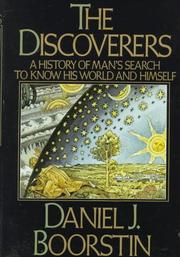
The Discoverers
How humans discovered time, geography and nature; a history of knowing
Summary
Boorstin writes a history of discovery organised by what was discovered rather than by chronology or nation: time, the earth and the seas, nature, and society. He covers the invention of the calendar and the clock, the development of cartography and navigation, the voyages of exploration, the microscope and telescope, the classification of species, the discovery of geological time and evolution, and the emergence of history, economics and the social sciences.
His organising argument is that the main obstacle to discovery has been not ignorance but confident false knowledge. He returns repeatedly to cases where an existing authoritative framework prevented people from seeing what was in front of them: Ptolemaic geography, Galenic medicine, biblical chronology, the Chinese decision to end the Zheng He voyages, and the scholastic reliance on classical authority. His term for this is the illusion of knowledge, and he treats it as the recurring enemy of progress.
The book is a synthesis for general readers, wide-ranging and readable, and it works well as a source of specific historical cases about how frameworks blind people. Its weaknesses are those of the genre and the period. It is heavily Western in emphasis despite chapters on China and Islam, its treatment of non-European science is thin and sometimes dismissive, and specialists have noted numerous small errors. Boorstin was Librarian of Congress and wrote as a public historian rather than as a researcher of primary sources. The framing of discovery as heroic individual achievement has been substantially revised by later history of science.
Key takeaways 7
- The main obstacle to discovery has been confident false knowledge rather than ignorance, because an existing authoritative framework prevents people from seeing anomalies.
- The mechanical clock, by making time an abstract measurable quantity independent of the sun, restructured work, navigation and science.
- Advances in navigation depended on solving the longitude problem, which required accurate portable timekeeping rather than better astronomy.
- China possessed the maritime capability to explore the world in the fifteenth century and abandoned it by political decision, which shows technological capability does not determine outcomes.
- The microscope and telescope each revealed that the world contained entire categories of things nobody had suspected, which forced the abandonment of complete existing systems.
- Establishing the true age of the earth required overcoming a chronology derived from scripture that had the status of settled fact.
- Systems of classification determine what can be observed, so a new classification is frequently the discovery rather than a description of one.
Who should read it
Readers who want a broad history of how established frameworks blocked discovery, useful as a source of cases about institutional blindness.
Who recommended it 2 · 1 direct
Similar books 6
Chosen by shared topics, the entries that hold them, and the people who recommended both.

How scientists came to know what they know, from cosmology and geology to biology.
Recommended by: Balaji S. Srinivasan, Jim Collins and 5 others

Why startups should build something new and own a small market before growing.
Recommended by: Balaji S. Srinivasan, Eric Weinstein and 36 others


How the sciences and humanities can be unified by causal links from physics up.
“I was inspired by E. O. Wilson's book Consilience, which came out in 1998 and is a book I'd recommend.” — Michael Mauboussin
Source: MOI Global interview with Michael Mauboussin
Recommended by: Michael Mauboussin, Mohnish Pabrai

Innovation is gradual, collective and bottom-up, not the work of lone inventors.
“It's a must-read for entrepreneurs and government officials who want to either be innovative themselves or foster innovation.” — Naval Ravikant
Source: Nav.al — 'Matt Ridley: How Innovation Works, Part 2'
Recommended by: Naval Ravikant, Balaji S. Srinivasan
The search for the periodic table; reasoning from the elements upward
Recommended by: Bill Gates
Where it sits in the reference 2
Topics