Updates

  1. Person pages list letters, writing, profiles and links as sortable tables with filters, and show each person's companies as links; Fund letters show each letter's description in its own column.
  2. Experts show a checked job title and a short description of each person; 30 more people have photographs.
  3. Every company, fund, university and publication the experts work for has a page listing the people there.
  4. Fund letters show each letter's thesis and filter by it; 225 person pages list the essays, columns and newsletter issues the person wrote.
  5. Person pages list every essay and newsletter issue a person wrote, and their own books as a table in List view.
  6. Recommends shows the five largest kinds of book and the rest under More; browse pictures load sooner.
  7. Podcasts and talks link the original episode, filter by Audio and video or Press, and list each publisher once.
  8. Pages are wider, Recommends has List and Grid, and a filter clicked again turns off.
  9. Book cards sit in a ruled grid with Open Library and Goodreads links and each book's one-line note.
  10. Funds is now Investors; each investor's styles are buttons that filter the table.
  11. Podcasts and talks on a person's page filter by year and publisher and show as a list or a grid of pictures.
  12. Quotes show only people's own words: 472 summaries written by list sites are gone.
  13. Country pages open from Browse again, and every link on the shelf lands on a page.
  14. Subject and person pages show their sections as tabs, and each book appears once on a person's page.
  15. Book cards show the quote, who said it and the source; grids show five cards to a row.
  16. On a phone, a menu holds the sections, search, Updates, Feedback and dark mode.
  17. Feedback takes a screenshot of the page with no browser prompt, opens a screenshot full size when you click it, and clears itself once sent.
  18. Book cards are centred, search names the topic each book sits in, and any text cut short shows whole on hover.
  19. Search groups its results by kind: people, companies, geographies, subjects, topics, books, funds, fund letters and papers.
  20. The Books table lists who recommended each book by name, and the browser tab names the section you are in.
  21. Feedback can take a screenshot of the page, or one you paste or choose, and opens in the corner beside Updates.
  22. Each rail button reopens its section where you left it, and Browse, Table and People show on every book and subject page.
  23. Filters grey out choices that hold nothing instead of hiding them, and Books › People filters by authors or recommenders.
  24. Feedback takes a subject line and up to three screenshots.
  25. Biographies are grouped by the person they are about: 41 new pages, from Abraham Lincoln to Lee Kuan Yew.
  26. Sport splits into 23 sports, and Religion into one topic per faith.
  27. Book lists show as cards: the cover, one recommendation quote and every recommender by name.
  28. Seventeen subjects that had two or three pages under different names now have one page each.
  29. Every page lists its Experts as authors and recommenders, with a link to them on the Experts tab.
  30. Economics, Financial history, Financial panics and Accounting are subjects of their own, with one page per financial crisis.
  31. Book, person and subject pages open inside the app, so the tabs stay in view.
  32. 996 more book covers, and photographs or logos for 227 more people and companies.
  33. Books › Browse shows every subject as cards, and the rail holds Fund letters, Papers, Experts, Books and Funds.
  34. Every topic over 150 books splits into narrower topics, each with a page of its own.

Send feedback

What is it?
Screenshots, up to 3 (optional)
or paste one with Ctrl+V

We use your email only to reply to you.

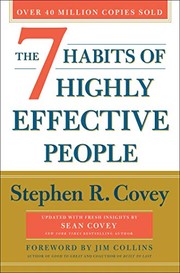
The 7 Habits of Highly Effective People

The 7 Habits of Highly Effective People

Stephen Covey, Stephen R. Covey
1989
T2 374 pages · about 6h 14m to read Open Librarygoodreads

The best-known framework for personal effectiveness and priority setting

Summary

Covey builds a sequence of seven habits organised into private victory, public victory and renewal. The first three concern independence: be proactive, begin with the end in mind, and put first things first. The next three concern interdependence: think win-win, seek first to understand then to be understood, and synergise. The seventh, sharpen the saw, covers renewal across physical, mental, social and spiritual dimensions.

His framing argument is a distinction between the character ethic, which he found in American success literature before roughly 1920, and the personality ethic of technique and image that replaced it. He argues that techniques applied without underlying character produce short-term results and long-term failure, and that lasting change requires working on paradigms rather than on behaviour.

The most used tool is the time management matrix, which sorts activities by urgency and importance and argues that effectiveness comes from expanding quadrant two, meaning important activities that are not urgent, at the expense of quadrant three, urgent activities that are not important. The circle of concern and circle of influence distinction is the other durable device, arguing that proactive people work inside what they can affect and that reactive people spend energy on what they cannot.

The book is long, repetitive and heavy with terminology. The evidence is anecdotal and drawn from Covey's consulting and family life, with a religious framework that is implicit rather than stated. Later editions and the surrounding business have diluted it. The matrix, the circles and the win-win framing survive as tools independent of the surrounding system.

Key takeaways 8

  1. Effectiveness rests on character rather than on technique, so methods applied without the underlying disposition fail over time.
  2. A person chooses their response to any stimulus, which means responsibility for outcomes always sits with them rather than with conditions.
  3. Working inside your circle of influence expands it, while spending energy on your circle of concern shrinks it.
  4. Every project is created twice, first mentally and then physically, so the mental creation determines what the physical one can be.
  5. Important activities that are not urgent, including planning, prevention and relationship building, are the source of effectiveness and are always displaced by urgent unimportant ones.
  6. Most people listen with the intention of replying rather than understanding, which is why they fail to influence.
  7. Agreements should be structured so both parties gain, and any arrangement where one party loses will not hold.
  8. Production and the capacity to produce must be balanced, since maximising output degrades the asset producing it.

Who should read it

Managers and founders who want the time management matrix and the influence distinction, willing to extract them from a long and repetitive framework.

About Stephen Covey

American leadership author and educator who founded the Covey Leadership Center, later merged into FranklinCovey.

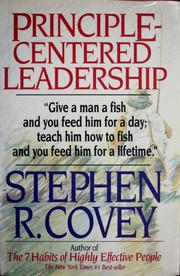
The 7 Habits of Highly Effective People organises personal effectiveness around principles rather than techniques, and its working parts - the circle of influence, the urgency-importance quadrants, begin with the end in mind, think win-win - entered standard managerial vocabulary. Principle-Centered Leadership applies the same framework at organisational scale.

Covey Leadership Center

Who recommended it 12 · 4 direct

“…books I've recommended, highlighted to death, or forced on friends.”

Ali Abdaalreported
Mr. Beastreported
Nick Huberreported
Noah Kaganreported
Simon Sinekreported

Similar books 6

Chosen by shared topics, the entries that hold them, and the people who recommended both.

Eric Partaker · 2020

Recommended by: Ali Abdaal

Ray Dalio · 2017

Decision rules from building Bridgewater: radical truth and radical transparency.

T4 QBQ!
John G. Miller · 2001

Recommended by: The Barefoot Investor

Reid Hoffman, Ben Casnocha · 2012

Run your career the way an entrepreneur runs a startup.

Stephen Covey · 1989

Applies the Seven Habits to organisations: lead by fixed principles, not by values.

Recommended by: Mohnish Pabrai

Where it sits in the reference 4

Journalists
Business themes
Mental models
Business themes

Topics

Productivity and HabitsLeadershipMotivation and success mindset