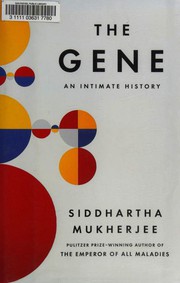
The Gene
History of heredity from Mendel to gene editing
Summary
Mukherjee, an oncologist who wrote The Emperor of All Maladies, writes the history of the gene as a concept from Mendel and Darwin through the molecular biology of the twentieth century to genome editing, interwoven with his own family history of mental illness across three generations.
The historical narrative covers Mendel's peas and their forty-year neglect, Darwin's lack of any inheritance mechanism, the eugenics movement in Britain and the United States and its adoption in Nazi Germany, the identification of DNA as the hereditary material, the double helix, the cracking of the genetic code, recombinant DNA and the Asilomar conference where scientists imposed a moratorium on themselves, the Human Genome Project, and CRISPR.
The ethical argument is the book's purpose. Mukherjee treats the eugenics history not as an aberration but as what happens when genetic knowledge meets the desire to improve populations, and he uses it to frame the questions raised by embryo selection and germline editing. His distinction between correcting a clearly pathological single-gene condition and selecting for traits is where he locates the line, while acknowledging that the line does not hold under examination.
The personal material about his uncles and cousin with schizophrenia carries the argument about what genetic risk means for a family before any intervention is available. The book is long and the science is explained at a general level. Specialists find the coverage of recent genomics compressed. It was published in 2016 and predates the He Jiankui case and the subsequent tightening of norms. It is the best available single-volume history of the concept and of its uses.
Key takeaways 8
- The gene as a concept was reconstructed several times, from Mendel's abstract unit through the physical chromosome to DNA and to a regulated sequence.
- Mendel's work was published in 1866 and ignored for over three decades, which delayed the reconciliation of inheritance with natural selection.
- Eugenics was a mainstream scientific and political movement in Britain and the United States before Germany applied it, and it followed from genetic knowledge rather than contradicting it.
- Recombinant DNA prompted scientists to impose a research moratorium on themselves at Asilomar, which is the precedent for self-regulation in a new technology.
- Most psychiatric and complex conditions involve many genes with small effects interacting with environment, which defeats single-gene explanations.
- Genetic risk is not a diagnosis, and knowing a probability without an available intervention changes a family's life without improving it.
- Correcting a clearly pathological single-gene condition and selecting for desirable traits are different acts, and the boundary between them does not survive examination.
- The book predates the first germline-edited births and the subsequent tightening of scientific norms.
Who should read it
Readers who want the history of genetics together with the ethical questions that genome editing has made immediate.
Who recommended it 4 · 1 direct
Similar books 6
Chosen by shared topics, the entries that hold them, and the people who recommended both.

The history of molecular biology from the 1930s to the 1970s, told by its makers.
Recommended by: Naval Ravikant

Twenty-three chapters, one per chromosome, each using a gene to open a subject.
“I highly recommend Genome as well, to figure out the rational basis behind ethics and the origin of virtue.” — Naval Ravikant
Source: Nav.al — 'Matt Ridley: How Innovation Works, Part 2' (Naval's podcast, edited transcript)
Recommended by: Charlie Munger, Mohnish Pabrai and 2 others

A biography of cancer, by a physician and oncologist.
Recommended by: Andrew Chen, Bill Gates, Laura R Walker and 1 other
Human behaviour read from evolutionary biology; a Munger latticework staple
Recommended by: Charlie Munger, Mohnish Pabrai

How ancient DNA has rewritten the story of human prehistory and migration.
Recommended by: Balaji S. Srinivasan, Marc Andreessen and 2 others

Behavioural genetics on how much of an outcome is inherited
Recommended by: James Cameron, Michael Mauboussin
Where it sits in the reference 2
Topics