Updates

  1. Person pages list letters, writing, profiles and links as sortable tables with filters, and show each person's companies as links; Fund letters show each letter's description in its own column.
  2. Experts show a checked job title and a short description of each person; 30 more people have photographs.
  3. Every company, fund, university and publication the experts work for has a page listing the people there.
  4. Fund letters show each letter's thesis and filter by it; 225 person pages list the essays, columns and newsletter issues the person wrote.
  5. Person pages list every essay and newsletter issue a person wrote, and their own books as a table in List view.
  6. Recommends shows the five largest kinds of book and the rest under More; browse pictures load sooner.
  7. Podcasts and talks link the original episode, filter by Audio and video or Press, and list each publisher once.
  8. Pages are wider, Recommends has List and Grid, and a filter clicked again turns off.
  9. Book cards sit in a ruled grid with Open Library and Goodreads links and each book's one-line note.
  10. Funds is now Investors; each investor's styles are buttons that filter the table.
  11. Podcasts and talks on a person's page filter by year and publisher and show as a list or a grid of pictures.
  12. Quotes show only people's own words: 472 summaries written by list sites are gone.
  13. Country pages open from Browse again, and every link on the shelf lands on a page.
  14. Subject and person pages show their sections as tabs, and each book appears once on a person's page.
  15. Book cards show the quote, who said it and the source; grids show five cards to a row.
  16. On a phone, a menu holds the sections, search, Updates, Feedback and dark mode.
  17. Feedback takes a screenshot of the page with no browser prompt, opens a screenshot full size when you click it, and clears itself once sent.
  18. Book cards are centred, search names the topic each book sits in, and any text cut short shows whole on hover.
  19. Search groups its results by kind: people, companies, geographies, subjects, topics, books, funds, fund letters and papers.
  20. The Books table lists who recommended each book by name, and the browser tab names the section you are in.
  21. Feedback can take a screenshot of the page, or one you paste or choose, and opens in the corner beside Updates.
  22. Each rail button reopens its section where you left it, and Browse, Table and People show on every book and subject page.
  23. Filters grey out choices that hold nothing instead of hiding them, and Books › People filters by authors or recommenders.
  24. Feedback takes a subject line and up to three screenshots.
  25. Biographies are grouped by the person they are about: 41 new pages, from Abraham Lincoln to Lee Kuan Yew.
  26. Sport splits into 23 sports, and Religion into one topic per faith.
  27. Book lists show as cards: the cover, one recommendation quote and every recommender by name.
  28. Seventeen subjects that had two or three pages under different names now have one page each.
  29. Every page lists its Experts as authors and recommenders, with a link to them on the Experts tab.
  30. Economics, Financial history, Financial panics and Accounting are subjects of their own, with one page per financial crisis.
  31. Book, person and subject pages open inside the app, so the tabs stay in view.
  32. 996 more book covers, and photographs or logos for 227 more people and companies.
  33. Books › Browse shows every subject as cards, and the rail holds Fund letters, Papers, Experts, Books and Funds.
  34. Every topic over 150 books splits into narrower topics, each with a page of its own.

Send feedback

What is it?
Screenshots, up to 3 (optional)
or paste one with Ctrl+V

We use your email only to reply to you.

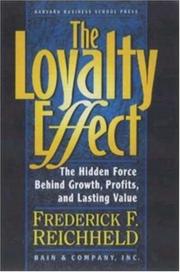
The Loyalty Effect

The Loyalty Effect

Frederick F. Reichheld, Thomas Teal
1996
T2 323 pages · about 5h 23m to read Open Librarygoodreads

Retention economics: why loyal customers and employees drive returns

Summary

Reichheld, a Bain consultant, argues that customer, employee and investor retention are the primary drivers of profitability and growth, and that most businesses measure and manage none of the three properly.

The economic argument is worked out for customers. A retained customer becomes more profitable over time through a sequence of effects: the acquisition cost is amortised over more years, base profit accumulates, purchase volume grows, operating costs fall as the customer learns to use the service, referrals generate new customers at no acquisition cost, and price premium becomes available as the relationship deepens. Reichheld presents the arithmetic showing that a five percentage point improvement in retention rate can raise customer lifetime value by a large multiple depending on the industry.

He extends the argument to employees, showing that turnover destroys the relationship knowledge that customer retention depends on, and to investors, arguing that fast-turnover shareholders push management toward decisions that damage the other two forms of loyalty. His cases include State Farm, USAA, Lexus, MBNA and Leo Burnett.

The book has had enormous influence and Reichheld later developed the Net Promoter Score from this work. The main criticism is causal direction: profitable customers are also more likely to stay, so retention and profitability are correlated without retention necessarily causing profitability. Later research has found the loyalty-profitability relationship weaker and more industry-specific than Reichheld claims, and the retention arithmetic is sensitive to assumptions the book does not stress.

Key takeaways 7

  1. A retained customer becomes more profitable over time through amortised acquisition cost, growing purchase volume, falling service cost, referrals and price premium.
  2. Small improvements in retention rate produce large increases in customer lifetime value, because the effects compound across several channels at once.
  3. Employee turnover destroys the relationship knowledge that customer retention depends on, so the two cannot be managed separately.
  4. Fast-turnover shareholders push management toward decisions that damage customer and employee retention, which makes investor loyalty part of the same system.
  5. Most companies do not measure retention accurately because they count transactions rather than relationships and do not track customers who leave.
  6. Referrals from existing customers acquire new customers at no cost and with better retention characteristics than paid acquisition produces.
  7. Growth achieved by acquiring customers who will not stay destroys value while appearing in every reported metric as success.

Who should read it

Operators in subscription and relationship businesses who want the economic argument for retention, read with awareness that the causal claim is contested.

Who recommended it 1 · 1 direct

“In his seminal book, The Loyalty Effect, Fred Reichheld shows that a 5 percentage point improvement in retention rate”

Similar books 6

Chosen by shared topics, the entries that hold them, and the people who recommended both.

David A. Aaker · 1996

How to build and manage a brand, using the four parts of brand equity.

Mark Jeffery · 2010

Fifteen metrics that show which marketing spending works and which does not.

Recommended by: Mohnish Pabrai, Jeff Bezos

Adam Morgan · 1999

Challenger-brand economics against a dominant incumbent.

Recommended by: Vinod Khosla

Madhavan Ramanujam, Georg Tacke · 2016

Set the price before you design the product, since most failures are pricing ones.

Tien Tzuo · 2018

Why firms are moving from selling units to selling ongoing subscriptions, and how.

Robbie Kellman Baxter · 2020

Retention, pricing tiers and the mechanics of renewal.

Where it sits in the reference 4

Business models
Business models
Business themes
Business themes

Topics

Business and ManagementSales and MarketingSelling and customer service