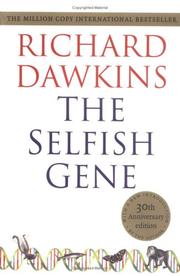
The Selfish Gene
Summary
Dawkins argues that natural selection operates on genes rather than on individuals or groups, and that organisms are best understood as vehicles built by genes to make copies of themselves. The book synthesises work by Hamilton on kin selection, Trivers on reciprocal altruism and parental investment, and Maynard Smith on evolutionarily stable strategies, and presents it for a general reader.
The gene-centred view explains behaviour that individual-level selection cannot. Altruism toward relatives follows from shared genes, weighted by relatedness, which is Hamilton's rule. Reciprocal altruism between unrelated individuals is stable where interactions repeat. Dawkins also uses game theory extensively, showing how populations settle into stable mixes of strategies such as hawk and dove, and why a strategy cannot be evaluated except against the population it faces.
The final chapter introduces the meme as a unit of cultural transmission subject to the same selection logic as genes, which is where the word came from. Later editions add two chapters, including one developing the extended phenotype, the argument that a gene's effects extend beyond the organism's body into structures and other organisms' behaviour.
The title has caused forty years of misreading. Dawkins does not claim that people are selfish or that selfishness is natural, and he says explicitly that humans can rebel against gene interests. Group selection advocates, including David Sloan Wilson, continue to dispute the framework, and multilevel selection has regained support. The meme concept has produced little research. The core argument remains standard in evolutionary biology, and for business readers its value is in showing how apparently altruistic behaviour follows from replicator interests.
Key takeaways 8
- Natural selection acts on genes rather than on individuals or groups, and organisms function as temporary vehicles for gene replication.
- Altruism toward relatives follows directly from shared genes, with help predicted by the degree of relatedness and the ratio of cost to benefit.
- Cooperation between unrelated individuals is stable only where interactions repeat and defection can be punished.
- An evolutionarily stable strategy cannot be invaded by any alternative once most of the population adopts it, which means the best strategy depends on what everyone else is doing.
- Behaviour that appears to serve the group can be fully explained by gene-level interest, so group-benefit explanations are usually unnecessary.
- Parents and offspring have partially conflicting genetic interests, which predicts observable family conflict rather than pure cooperation.
- Cultural units can replicate, vary and compete for attention in the same way genes do, which is the meme argument.
- Humans can act against the interests of their genes, and Dawkins treats this capacity as the one genuine exception to the framework.
Who should read it
Readers who want the mechanism behind cooperation, competition and stable strategies stated rigorously, which transfers to thinking about incentives in organisations.
Who recommended it 12 · 3 direct
Similar books 6
Chosen by shared topics, the entries that hold them, and the people who recommended both.
How cooperation and morality evolved from self-interest, via the prisoner's dilemma.
“I really highly, highly recommend picking up Genome, The Red Queen, Origins of Virtue, The Rational Optimist, and The Evolution of Everything.” — Naval Ravikant
Source: The Tim Ferriss Show — Naval Ravikant Q&A, full transcript
Recommended by: Mohnish Pabrai, Naval Ravikant, Ryan Holiday
Species change over time as natural selection favours heritable variations.
“may have done more than any, with the exception of the Bible, to shape man's self-perception” — Nick Sleep
Source: Nomad Investment Partnership, Interim Letter for the period ended June 30th, 2009, p. 158
Recommended by: Jim Collins, Mohnish Pabrai, Naval Ravikant and 5 others

Twenty-three chapters, one per chromosome, each using a gene to open a subject.
“I highly recommend Genome as well, to figure out the rational basis behind ethics and the origin of virtue.” — Naval Ravikant
Source: Nav.al — 'Matt Ridley: How Innovation Works, Part 2' (Naval's podcast, edited transcript)
Recommended by: Charlie Munger, Mohnish Pabrai and 2 others

Sex evolved as a defence against parasites, and that shapes human mating.
“I really highly, highly recommend picking up Genome, The Red Queen, Origins of Virtue, The Rational Optimist, and The Evolution of Everything.” — Naval Ravikant
Source: The Tim Ferriss Show — Naval Ravikant Q&A, full transcript
Recommended by: Mohnish Pabrai, Naval Ravikant, Seth Klarman and 1 other

How natural selection, not a designer, produces the complexity of living things.
Recommended by: Jim Collins, Mohnish Pabrai and 2 others
Human behaviour read from evolutionary biology; a Munger latticework staple
Recommended by: Charlie Munger, Mohnish Pabrai
Where it sits in the reference 2
Topics