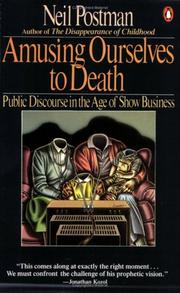
Amusing Ourselves to Death
Television as a medium that reshapes public discourse into entertainment
Summary
Postman argues that the form of a medium determines what kind of content it can carry, and that the shift from print to television changed public discourse from exposition to entertainment. His framing device is the contrast between Orwell, who feared information would be withheld, and Huxley, who feared people would be given so much amusement that they would stop caring, and Postman argues that Huxley was right.
His historical section documents what he calls the age of exposition. He uses the Lincoln and Douglas debates, in which audiences listened to seven hours of complex argument, as evidence that print-based culture produced a public capable of following extended reasoning. He argues that typography imposes a linear, propositional and analytical structure on thought, and that a culture organised around reading develops different cognitive habits than one organised around images.
The television section argues that the medium requires entertainment, that this is not a failure of programming but a property of the form, and that applying it to news, politics, religion and education degrades all four. His treatment of news as a sequence of decontextualised fragments introduced by the phrase now this is the most cited passage. He also argues that television advertising replaced argument about products with images about consumers.
The book was published in 1985 and its predictions about political discourse anticipated much of what followed on the internet, which Postman did not live to analyse. Critics argue that he romanticises the print era, that the Lincoln and Douglas audiences were not typical, and that he underestimates television's capacity for serious work. The argument that the medium constrains the content is the durable contribution.
Key takeaways 8
- The form of a medium determines what kind of content it can carry, so a change in medium changes what public discourse can contain.
- Print imposes linear, propositional and analytical structure on thought, and a reading culture develops different cognitive habits than an image culture.
- Television requires entertainment as a condition of the form, which means applying it to news, politics, religion or education degrades each of them.
- News delivered as a sequence of decontextualised fragments produces the sensation of being informed without the substance of it.
- Information disconnected from any action a person can take is not information in any useful sense, which Postman argues describes most news consumption.
- Political persuasion moved from argument about positions to images about the candidate, which follows from the medium rather than from any decline in politicians.
- Huxley's fear that people would be pacified by amusement describes the situation better than Orwell's fear that information would be suppressed.
- Postman romanticises the print era and the Lincoln and Douglas audiences he cites were not representative of the public generally.
Who should read it
Readers thinking about how digital platforms shape discourse, who want the argument that the medium constrains the content rather than merely carrying it.
Who recommended it 6 · 1 direct
Similar books 6
Chosen by shared topics, the entries that hold them, and the people who recommended both.
How a culture hands its judgement to machines, statistics and technical experts.
Recommended by: Patrick Collison, Tristan Harris
Why most media companies destroy shareholder value: few have barriers to entry.
Recommended by: Keith Rabois
How media from the penny press to social media capture attention and resell it.
How to make sense of the daily torrent of news, and what it does to our minds.
Recommended by: Andrew Wilkinson, Antonio García Martínez
Insider account of Facebook's ads business by a product manager.
Recommended by: Mohnish Pabrai, Nat Eliason, Alfred Lin and 3 others
How shared fictions such as money, nations and gods let humans cooperate at scale.
“…books I've recommended, highlighted to death, or forced on friends.” — Andrew Wilkinson
Source: Andrew Wilkinson's Bookshelf, neverenough.com
Recommended by: Andrew Wilkinson, Bill Gates, Mohnish Pabrai and 38 others
Where it sits in the reference 1
Topics