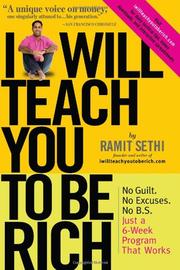
I Will Teach You To Be Rich
Sethi's contribution to money psychology is behavioral rather than analytical: he designs financial systems that work with human laziness and inconsistency rather than against them. His argument that automation beats willpower as a financial strategy is well-supported by the literature on ego depletion and habit formation.
Summary
Sethi gives a six-week programme covering credit cards, banking, investment accounts, automation and spending, aimed at people in their twenties and thirties who have not organised their finances. The argument is that most personal finance advice fails because it demands ongoing discipline, and that the alternative is a system set up once that runs automatically.
The programme sequence is concrete: optimise credit cards and pay off debt, open a high-interest savings account and a fee-free current account, open investment accounts and contribute to any employer-matched retirement plan first, decide on an allocation and choose low-cost index or target-date funds, and then automate all transfers so that saving and investing occur before any spending decision is made.
His distinctive positions are that cutting small expenses produces less than negotiating large ones, that people should spend extravagantly on what they genuinely value and cut ruthlessly on what they do not, and that increasing income has a higher ceiling than reducing costs. He gives negotiation scripts for salaries, bank fees and bills. He is direct about the limits of active investing, recommending low-cost index funds and arguing that stock picking and market timing are not where a reader's effort should go.
The book is written in a deliberately abrasive register that some readers dislike. The specific products, rates and account names are dated in every edition. The advice is basic to anyone with financial training, and the automation argument is the actual contribution: it removes the requirement for ongoing willpower, which is where most personal finance plans fail.
Key takeaways 8
- Automating transfers so that saving and investing occur before any spending decision removes the requirement for ongoing discipline.
- Cutting small recurring expenses produces less than negotiating large ones such as salary, rent and insurance.
- Spending extravagantly on what you genuinely value is acceptable provided you cut ruthlessly on what you do not.
- Increasing income has a far higher ceiling than reducing expenses, so effort should go there first.
- Employer-matched retirement contributions should be captured in full before any other investment, since the match is an immediate return.
- Low-cost index funds or target-date funds are the correct default, and stock picking is not where an individual's effort produces returns.
- A system that requires no ongoing decisions outperforms an optimal plan that requires continuous attention.
- Starting an imperfect plan immediately beats waiting to construct an optimal one, because the delay costs more than the imperfection.
Who should read it
People early in their careers who have not organised their finances and need an automated system rather than investment theory.
Who recommended it 5 · 2 direct
Similar books 6
Chosen by shared topics, the entries that hold them, and the people who recommended both.
Twenty short essays on why behaviour matters more than knowledge with money.
“…books I've recommended, highlighted to death, or forced on friends.” — Andrew Wilkinson
Source: Andrew Wilkinson's Bookshelf, neverenough.com
Recommended by: Andrew Wilkinson, Nat Eliason, Ali Abdaal and 10 others
A nine-step programme that counts spending in hours of life energy.
Recommended by: Ali Abdaal, Graham Stephan and 1 other
Survey research showing most American millionaires live modestly and save hard.
Recommended by: Mohnish Pabrai, Andrew Lokenauth and 2 others
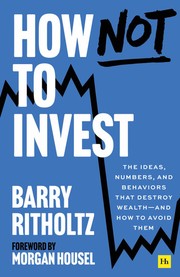
Common investing mistakes catalogued by a working asset manager
“Barry Ritholtz dreamed up the perfect concept and wrote the perfect book to suit it” — Christopher Bloomstran
Source: Semper Augustus 2025 Letter to Clients, 'Books and Music', p. 88
Recommended by: Christopher Bloomstran
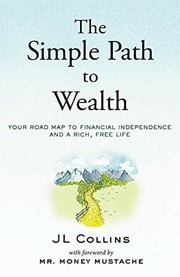
JL Collins distilled his 'stock series' blog posts into this short, opinionated guide. The core advice is stark: invest in VTSAX, avoid debt, and ignore the noise. Collins wrote it as a letter to his daughter, and that framing keeps it practical rather than academic. The FIRE community treats it as essential background reading.
Recommended by: Mr. Money Mustache

Why Wall Street grows rich on fees while its clients' results stay ordinary.
“recommended reading for those with a healthy disdain for Wall Street and its practices as well as an interest in post-boom psychology” — Nick Sleep
Source: Nomad Investment Partnership, Interim Report for the period ended June 30th, 2002, p. 10
Recommended by: Mohnish Pabrai, Nick Sleep, Warren Buffett and 4 others
Where it sits in the reference 2
Topics