
The Checklist Manifesto
Summary
Gawande, a surgeon, argues that failures in complex fields come increasingly from the failure to apply knowledge correctly rather than from lacking it, and that checklists address this specific problem. He distinguishes errors of ignorance, where the knowledge does not exist, from errors of ineptitude, where it exists and was not applied.
The evidence he builds on comes from aviation, where checklists were introduced after the 1935 B-17 crash, and from construction, where he examines how large buildings are coordinated through scheduled checks and submittal schedules. The central medical evidence is Peter Pronovost's central line infection checklist at Johns Hopkins, which reduced infection rates to near zero, and the World Health Organization surgical safety checklist that Gawande led, tested across eight hospitals in different countries. That study showed major complications falling by thirty-six percent and deaths by forty-seven percent.
He is specific about checklist design. Good checklists are short, usually five to nine items, focus on the killer items that are commonly missed rather than on every step, specify pause points, and are tested in practice. Read-do and do-confirm are the two formats. He argues that the introduction of a team briefing where everyone states their name and role is one of the most effective components, because it changes whether people speak up later.
The main criticism is that checklists have been applied where they do not fit, and that some replication studies of the surgical checklist, including a large Ontario study, found no effect, which suggests that implementation quality matters more than the instrument. Gawande's argument that professional autonomy resists checklists is well supported, and the resistance he documents applies equally in finance and management.
Key takeaways 8
- Failures in complex fields now come mostly from not applying available knowledge correctly rather than from lacking knowledge.
- A checklist protects against the routine steps that experts skip precisely because they are routine and appear beneath attention.
- Good checklists contain five to nine items covering commonly missed steps, not every step in the process.
- Checklists must specify pause points where the team stops, and must be tested in real use before adoption.
- A team briefing where each person states their name and role measurably increases the likelihood that someone raises a problem later.
- Highly trained professionals resist checklists because the instrument implies their expertise is insufficient, which is the main barrier to adoption.
- Complex systems require distributed authority combined with mandated communication checks, rather than central control of every decision.
- Where checklist studies show no effect, the failure is usually in implementation and team adoption rather than in the instrument.
Who should read it
Operators and investors running processes where expensive mistakes come from skipped known steps, wanting the design rules rather than the general idea.
Who recommended it 11 · 4 direct
“In his wonderful book, The Checklist Manifesto, Atul Gawande... explains the value of using a checklist to improve outcomes”
“My good friend, Guy Spier, observed that both of us have a pre-investment checklist, but no in-flight checklist. The pre-investment checklist has proven invaluable. It is important to periodically…”
Similar books 6
Chosen by shared topics, the entries that hold them, and the people who recommended both.
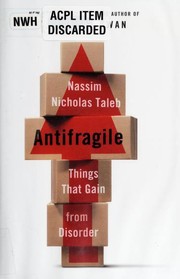
Incerto volume 4
“Nassim Taleb, author of the new book Antifragile, praises volatility and criticises those who would artificially damp it at great unseen cost. Taleb advises us to be 'anti-fragile'. This is exactly…” — Seth Klarman
Source: Klarman on Taleb's praise of volatility and what Baupost strives for
Recommended by: Mohnish Pabrai, Nat Eliason and 25 others
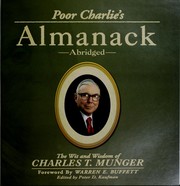
Speeches making the case for a latticework of mental models from many fields.
“…books I've recommended, highlighted to death, or forced on friends.” — Andrew Wilkinson
Source: Andrew Wilkinson's Bookshelf, neverenough.com
Recommended by: Andrew Wilkinson, Charlie Munger and 26 others
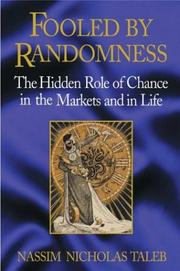
Why people mistake luck for skill, above all in markets.
“Fooled by Randomness is a serious, intellectually sophisticated book, well worth reading carefully. At times, the book is condescending. Nevertheless, there are some great insights.” — Barton Biggs
Source: Biggs on a sophisticated book worth reading carefully
Recommended by: Barton Biggs, Michael Mauboussin and 11 others
Rare, unforeseen, high-impact events drive history, explained only after the fact.
“The message of The Black Swan is how important it is to realize that the things everyone rules out can still come to pass.” — Howard Marks
Source: Oaktree memo 'The Limits to Negativism'
Recommended by: Howard Marks, Marc Andreessen, Nat Eliason and 18 others
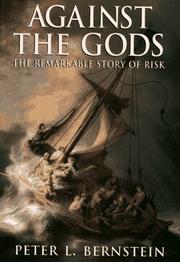
How people learned to measure risk, from early probability to portfolio theory.
“I think some of the books that are a must would be Peter Bernstein's book about risk, Against the Gods: The Remarkable Story of Risk.” — Charles de Vaulx
Source: De Vaulx naming Bernstein's book a must-read on risk
Recommended by: Charles de Vaulx, Jim Collins and 8 others
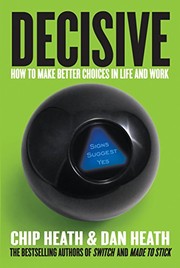
Four traps that ruin decisions, such as narrow framing, and a process to beat each.
Recommended by: Andrew Wilkinson, Mohnish Pabrai and 4 others
Where it sits in the reference 2
Topics