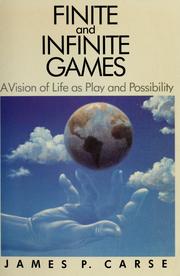
Finite and Infinite Games
Games played to win against games played to continue play
Summary
Carse, a professor of religion at New York University, distinguishes two kinds of game. A finite game is played for the purpose of winning, has fixed rules, defined boundaries and known players, and ends. An infinite game is played for the purpose of continuing the play, its rules change to prevent anyone from winning, its boundaries move, and it does not end.
The book proceeds through numbered aphoristic sections rather than through argument. Carse applies the distinction to war, sexuality, culture, religion, property, nature and death. His claim is that finite players play inside boundaries while infinite players play with boundaries, and that finite play is always contained within an infinite game because someone must choose to keep playing.
Some of his specific arguments are sharp. He treats titles and property as the mechanism by which finite victories are made permanent, and argues that property requires public recognition and therefore that wealth must be displayed and defended. He argues that a finite player plays to be powerful while an infinite player is strong, distinguishing power exercised within a bounded contest from strength that does not require an opponent. He treats theatricality against drama, where finite play follows a script toward a known outcome and infinite play remains genuinely open.
The book is deliberately obscure. Carse defines terms in ways that shift, and the aphoristic form prevents the reader from checking any claim. Its business readership comes largely through Simon Sinek's The Infinite Game, which simplifies the framework considerably and applies it to strategy in ways Carse did not. Read the original for the distinction itself, and expect philosophy rather than application.
Key takeaways 8
- A finite game is played to win and ends, while an infinite game is played to continue playing and its rules change to prevent an ending.
- Finite players play within boundaries and infinite players play with boundaries, which is the difference between competing and changing the terms of competition.
- Every finite game is contained within an infinite game, because someone must choose to start and to keep playing.
- A finite player seeks power, which exists only within a bounded contest, while strength does not require an opponent to be demonstrated.
- Titles and property exist to make the results of finite games permanent, which requires continuous public recognition to sustain.
- Whoever must play cannot play, since a game entered under compulsion is not a game.
- Finite play is theatrical, following a script toward a known ending, while infinite play remains genuinely undetermined.
- Culture is an infinite game and society is a finite one, and the two are permanently in tension.
Who should read it
Readers wanting the philosophical source of the finite and infinite game distinction, prepared for an aphoristic text that resists application.
Who recommended it 11 · 1 direct
Similar books 6
Chosen by shared topics, the entries that hold them, and the people who recommended both.
History read as an expanding series of non-zero-sum games
Recommended by: Mohnish Pabrai, Ev Williams, Nick Thompson and 1 other
Life in Nazi concentration camps, and logotherapy: finding meaning to survive.
“I have been deeply influenced by the existentialist and eminent psychiatrist Viktor Frankl, who wrote the perennial best seller Man's Search for Meaning, one of the most influential books I've ever…” — Frank Martin
Source: Martin on one of the most influential books he has read and reread
Recommended by: Frank Martin, Mohnish Pabrai, Nat Eliason and 24 others
A venture adviser on startups and the trap of the deferred life plan.
Recommended by: Nat Eliason, Patrick Collison, Ev Williams and 3 others

Twelve rules for living, each drawn from clinical practice, biology and myth.
Recommended by: Nat Eliason, Alex and Books, Ana Fabrega and 7 others

How television turned public discourse from argument into entertainment.
Recommended by: Nat Eliason, Keith Rabois, Matt Mullenweg and 3 others
Where it sits in the reference 1
Topics