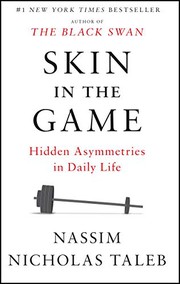
Skin in the Game
Incerto volume 5
Summary
Taleb argues that anyone who makes a decision affecting others must bear a share of the downside, and that most institutional failure traces to a broken link between decision and consequence. He applies the rule to bankers rescued by the state, to interventionist policy officials, to analysts and consultants who bear no cost for wrong advice, and to academics whose theories are never tested by exposure.
The book is organised around several distinct claims. Symmetry is an ethical requirement and also a filter for reliable information, since a person with exposure reveals more by their positions than by their statements. The minority rule states that an intransigent minority with a non-negotiable preference imposes its choice on a flexible majority, which explains outcomes such as most drinks being kosher. Taleb also distinguishes ensemble probability from time probability and argues that the difference explains why an individual with a ruin risk should not use expected value reasoning.
He attacks what he calls the intellectual yet idiot, meaning credentialed people who prescribe for populations whose lives they do not share, and he argues that the Lindy effect gives the survival of an idea or practice more evidentiary weight than a study does.
The book repeats material from Antifragile and Fooled by Randomness. The argument moves between ethics, epistemology and probability without keeping them separate, and the polemical passages consume space. The minority rule chapter and the ergodicity argument are original and useful. The insult-heavy sections are not. Practitioners use this book mostly as a way of checking whether an adviser's incentives match their advice.
Key takeaways 8
- Anyone who makes a decision affecting others must bear a share of the downside, and systems without that symmetry accumulate hidden risk.
- What a person owns or risks reveals their real beliefs more accurately than anything they say.
- An intransigent minority with a non-negotiable preference determines outcomes for a much larger flexible majority.
- A strategy with any probability of ruin is unacceptable regardless of expected value, because an individual lives one path rather than an ensemble.
- Practices and ideas that have survived a long time carry more evidentiary weight than recent studies, because time is the only real filter.
- Advisers, analysts and policy officials who bear no consequence for being wrong will systematically produce advice that transfers risk to others.
- Bailing out decision-makers while imposing losses on others creates the worst possible incentive structure.
- Expertise claimed without exposure to consequences should be discounted heavily, whatever the credentials behind it.
Who should read it
Investors and founders assessing whose advice to trust, and anyone designing incentive structures where the decision-maker is not the risk-bearer.
About Nassim Nicholas Taleb
Former options trader; Distinguished Professor of Risk Engineering, NYU Tandon; scientific adviser to Universa Investments
The Incerto is the primary source for how markets and institutions handle tail risk, and the accompanying technical work supplies the mathematics others cite.
Who recommended it 15 · 1 direct
Similar books 6
Chosen by shared topics, the entries that hold them, and the people who recommended both.
Incerto volume 4
“Nassim Taleb, author of the new book Antifragile, praises volatility and criticises those who would artificially damp it at great unseen cost. Taleb advises us to be 'anti-fragile'. This is exactly…” — Seth Klarman
Source: Klarman on Taleb's praise of volatility and what Baupost strives for
Recommended by: Mohnish Pabrai, Nat Eliason and 25 others
Rare, unforeseen, high-impact events drive history, explained only after the fact.
“The message of The Black Swan is how important it is to realize that the things everyone rules out can still come to pass.” — Howard Marks
Source: Oaktree memo 'The Limits to Negativism'
Recommended by: Howard Marks, Marc Andreessen, Nat Eliason and 18 others
Why people mistake luck for skill, above all in markets.
“Fooled by Randomness is a serious, intellectually sophisticated book, well worth reading carefully. At times, the book is condescending. Nevertheless, there are some great insights.” — Barton Biggs
Source: Biggs on a sophisticated book worth reading carefully
Recommended by: Barton Biggs, Michael Mauboussin and 11 others
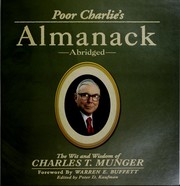
Speeches making the case for a latticework of mental models from many fields.
“…books I've recommended, highlighted to death, or forced on friends.” — Andrew Wilkinson
Source: Andrew Wilkinson's Bookshelf, neverenough.com
Recommended by: Andrew Wilkinson, Charlie Munger and 26 others
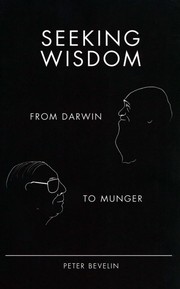
Builds out Munger's latticework idea from primary sources.
“…books I've recommended, highlighted to death, or forced on friends.” — Andrew Wilkinson
Source: Andrew Wilkinson's Bookshelf, neverenough.com
Recommended by: Andrew Wilkinson, Nat Eliason and 8 others
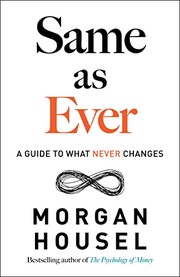
“There are many things that never change” — Andrew Wilkinson
Source: Newsletter
Recommended by: Andrew Wilkinson
Where it sits in the reference 8
Topics